


In these times of war, sky-high fuel prices, rising inflation and global interest rate hikes, you’d think the stock markets’ so-called fear index would be flashing red, but it’s not and that worries economist David Rosenberg .
“The VIX index reflects, to a large degree, the high level of complacency in the marketplace,” the president of Rosenberg Research & Associates Inc. said, referring to the Chicago Board Options Exchange Volatility Index (VIX).
The VIX, which is supposed to measure real-time volatility in the S&P 500 index , has been hanging around one-year lows of about 15 after spiking in the early days of the United States’s conflict with Iran.
VIX readings of zero to 15 indicate some optimism along with very low volatility; 15 to 25 show a certain amount of volatility, but not extreme; 25 to 30 mean there’s some market turbulence and increasing volatility; while anything over 30 indicates a highly volatile market coupled with some extreme swings, according to Toronto-Dominion Bank .

“The low level reflects the high level of confidence in the stock market,” Rosenberg said.
Other data points are also indicating investor confidence, including a record high reading of Market Vane, which tracks bullish and bearish sentiment amongst markets and investors.
“All these charts are lining up, telling you that the market, generally speaking, has a high level of confidence that the returns the S&P 500 is going to deliver now and into the future are going to be rather significant,” Rosenberg said.
But he said that confidence is misplaced and that market volatility is coming.
For one thing, Rosenberg expects there to be less hand-holding by the U.S. Federal Reserve of stock markets given that new Fed chair Kevin Warsh has signalled there will be less forward guidance on where policymakers think interest rates are headed.
“Lopsided” markets with everyone in on the same trade are also sending a danger signal to Rosenberg, as are the rising levels of margin debt, which is up 50 per cent over the past year.
“When you look at the VIX and you look at market positioning and you look at sentiment and you look at valuations, the only other time I can ever remember in my professional life such a lopsided market was back in the late 1990s,” he said, referring to the period just before the dot-com blowup.
Craig Basinger, chief market strategist at Purpose Investments Inc., said global headlines talking about US$100 oil and five per cent bond yields aren’t “market-friendly,” so one would expect a higher VIX.
“But behind that, you still have the residual positive influence of a great earnings season,” he said. “AI keeps oscillating, but it’s still largely positive for the market, and then you’ve got decent economic data that really hasn’t fallen out of bed.”
Furthermore, what was bad news one day gets digested pretty quickly or forgotten by markets.
For example, the VIX spiked to about 30 when the war on Iran started, but it rose past 50 on U.S. President Donald Trump’s so-called Liberation Day.
“The market just gets used to things,” Basinger said, adding it can react quickly to news while obscuring the longer-term impacts of events. “You know, $100 oil doesn’t cause a recession, but I’m gonna say six months of $100 oil probably does.”
Sign up here to get Posthaste delivered straight to your inbox.

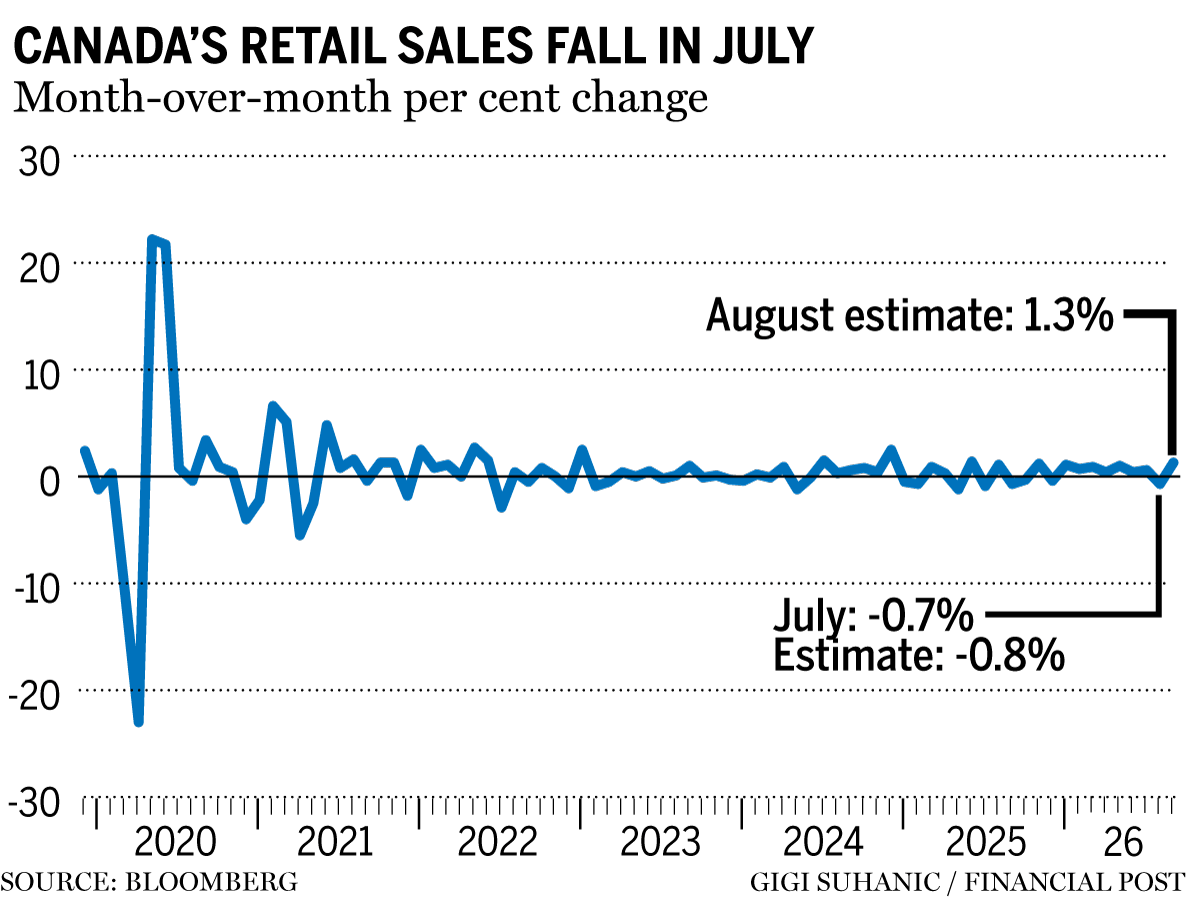
Canadian consumers pulled back on spending in July, a slowdown after stronger sales during the first half of the year.
Retail sales fell by 0.7 per cent monthly to $73.7 billion in July, the first drop since December 2025, according to data from Statistics Canada published on Thursday morning. The decrease followed a 0.6 per cent rise to $74.3 billion in sales in June. — Paula Tran, Financial Post
Read the full story here.

- Today’s Data: U.S. durable goods orders, University of Michigan sentiment index, Kansas City Fed services activity
- Earnings: District Metals Corp., Paramount Group Inc., Farmer Bros. Co.



- Competition Bureau reaches deal that could help lower gas prices
- Toronto and Vancouver drop to weakest housing markets in UBS global ranking
- Can Trump dump CUSMA? Yes he can, says trade lawyer

Glen is 45 years old, earns $110,000 a year, but has little savings and $100,000 left on the mortgage on his family home in Northern Ontario. Is it a good idea for him to borrow to invest in a registered retirement savings plan. Find out what FP Answers has to say.

The FP Atlantic Economic Report takes you behind the scenes of the business world in Atlantic Canada. We’ll bring you insights from CEOs, government leaders, investors and economists on what’s making the regional economy tick and where it’s heading next. Sign up here
McLister on mortgages
Want to learn more about mortgages? Mortgage strategist Robert McLister’s Financial Post column can help navigate the complex sector, from the latest trends to financing opportunities you won’t want to miss. Plus check his mortgage rate page for Canada’s lowest national mortgage rates, updated daily.
Financial Post on YouTube
Visit the Financial Post’s YouTube channel for interviews with Canada’s leading experts in business, economics, housing, the energy sector and more.
Today’s Posthaste was written by Gigi Suhanic with additional reporting from Financial Post staff and Bloomberg.
Have a story idea, pitch, embargoed report, or a suggestion for this newsletter? Email us at posthaste@postmedia.com .
Bookmark our website and support our journalism: Don’t miss the business news you need to know — add financialpost.com to your bookmarks and sign up for our newsletters here
Posthaste: The stock market's fear index is scary, says economist — but not for the reason you think
2026-09-25 12:00:15