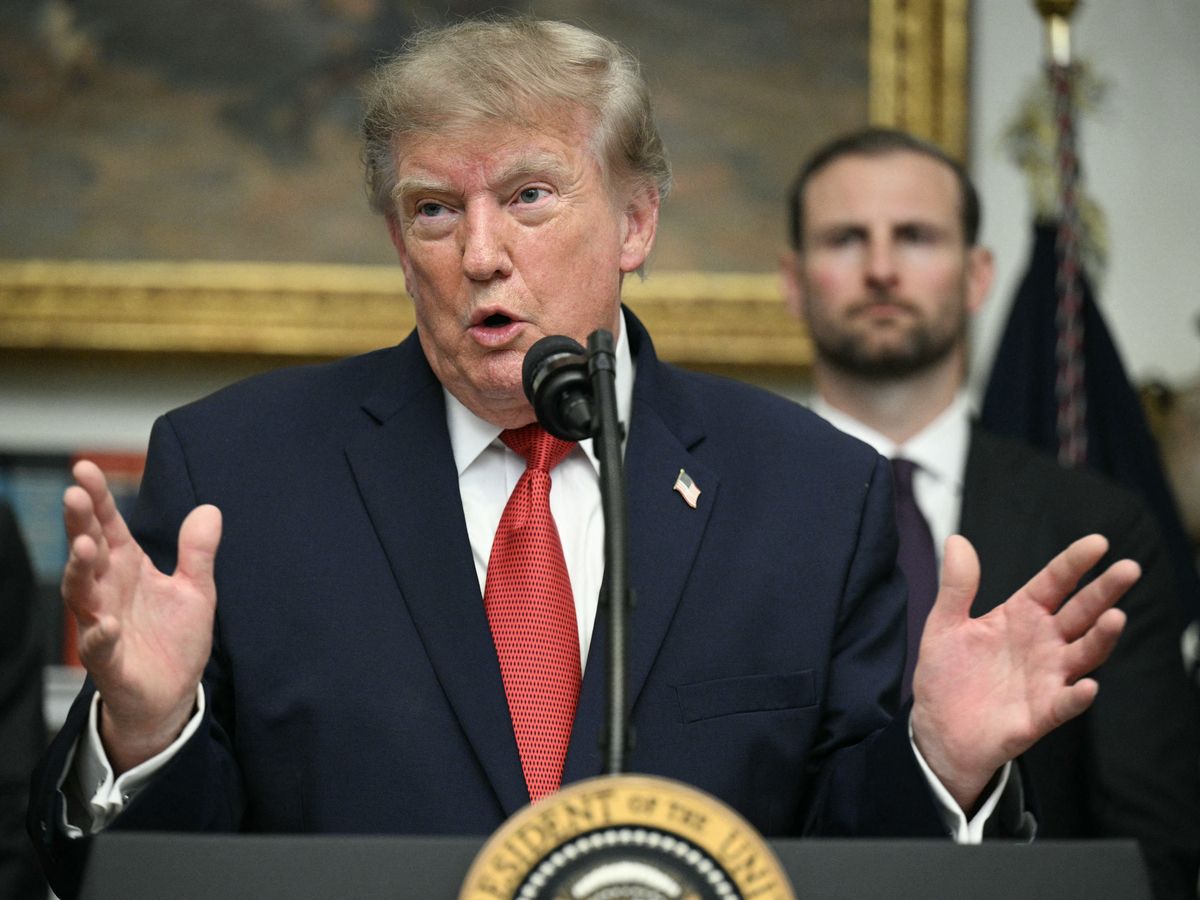

United States President Donald Trump announced late Tuesday night that Canada and the U.S. had reached a tentative trade deal and that he was hitting pause on the new 50 per cent tariffs for three days to allow for sides to finalize the documentation. U.S. Trade Representative Jamieson Greer congratulated Trump shortly after and said the deal had several provisions that protect American and Canadian workers and partners. But Prime Minister Mark Carney sounded a little more cautious. The Financial Post dives into what that might mean for Canada.
What happened?
Trump said in a proclamation on Tuesday that Canada “has expressed a commitment to remove the discriminations or unreasonable and unequal impositions at issue” and gave officials another three days to finalize the deal.
The proclamation did not provide many details, but in a Truth Social post Trump mentioned the Keystone XL pipeline project and said that it “may be awoken from the grave.”
Greer also said in a tweet that the tentative deal will include “comprehensive market access for all American goods, economic security commitments, digital trade alignment, and many important provisions that will continue to protect our market and American workers, along with our Canadian partners.”
Carney provided scant details about the deal.
“We are now moving towards an agreement that reinforces that Canadian advantage, including by securing the best terms in each of Canada’s most important strategic sectors and providing greater certainty about our future trading relationship,” he said in a statement on Wednesday afternoon.
Why the last-minute announcement?
Trump has a history of announcing, implementing, pausing and extending tariffs using emergency declarations. Last February, Trump repeatedly extended short-term pauses on the 25 per cent tariffs on Canada and Mexico before they were fully implemented.
The U.S. and Canada reached an historic 11th-hour deal that replaced the North American Free Trade Agreement with the Canada-U.S.-Mexico Agreement ( CUSMA ) in 2018.
“Most important international trade negotiations often end up literally at the wire. That’s very common,” said Daniel Trefler, an economics professor at the University of Toronto’s Rotman School of Management, in an interview.
So what’s in the deal?
Details about the tentative deal haven’t been made public and have yet to be finalized, so everything was still murky as of Wednesday afternoon.
Trump mentioned U.S. concessions in the ongoing talks during a news conference on Wednesday afternoon but didn’t elaborate.
“Got to give something, and we’re doing certain things. We’re paying a high number. We’re reducing it a little bit. It’s good for everybody, but our farmers are going to be thrilled. Our manufacturers are going to be thrilled,” he said.
While Trump suggested U.S. farmers would face no tariffs, Canada-U.S. Trade Minister Dominic LeBlanc expressed confidence that supply management would remain largely intact.
Trefler speculated that, based on Greer’s tweet, concessions were potentially made in regards to provincial bans on American alcohol, Canada’s dairy supply management system and retaliatory tariffs on U.S. automobiles — things the Trump administration had used to justify the new levies.
He added that Canada likely made concessions on several other items, including defence spending.
The Canadian government had already made concessions before trade negotiations began, such as axing the digital services tax and regulatory levies on large streaming services with over $25 million in Canadian revenues
“Canadians are rightfully angry, but we need to be careful that, in our anger, we don’t jump out of the frying pan and into the fire,” Trefler said.
“We will need to make concessions.”
What are the potential economic implications if concessions were made?
That depends on what concessions were.
“Canadian consumers do not have to buy American alcohol whether or not it’s on the shelves.… I see that as zero consequence,” Trefler said.
“We’re largely tinkering at the margins on dairy, but we’re still not letting huge amounts of dairy in. I tend not to be too concerned about that.”
However, concessions on Canada’s retaliatory tariffs on automobiles could have sweeping economic implications, he added.
Trump imposed a 25 per cent levy on foreign cars and trucks last year, but gave Canada and the U.S. a partial break on car parts made in the U.S. If half a car is assembled in the U.S., that would have an effective tariff rate of 12.5 per cent.
Canada and Mexico have been pushing for a tariff rate that applies to parts that aren’t sourced in North America instead.
“If the new levies apply to parts of the car that aren’t made in North America, then I think we could live with that. If it applies to the part of the car only made in the U.S., it’s a little bit tougher. Is it catastrophic? Not in the short run, but maybe over a period of 10 years, it could be bad, especially if places like Windsor and Exeter are massively dependent on the auto industry,” Trefler said.
Is there room for a more positive outcome?
Yes. TD Economics said in an updated Q&A article that if negotiations result in relief on the Section 232 tariffs on metal products and other goods, that would mean a clearer path towards CUSMA renewal that would be an upside risk to growth.
“For the time being, as the parameters of any new agreement are unknown, we assume no change to the tariff regime and expect Canadian growth to register 0.9 per cent in 2026, and 1.8 per cent in 2027,” the article read.
Derek Holt, vice president and head of capital markets economics at Scotiabank, said in a note published on Wednesday morning that the odds of Canada getting a trade deal before the U.S. midterm elections had gone up.
“If a deal that extends CUSMA and lowers uncertainty in a meaningful way were to be achieved, then it would be positive for Canadian economic growth and negligible for U.S. growth. It would buoy market and business sentiment toward Canada. It could put at ease consumer worries,” he wrote.
What about Keystone XL?
The expansion project was a bargaining chip for Trump throughout the trade negotiations. He posted on Truth Social post in February 2025 that he wanted to revive the project.
In October, the National Post reported that Carney raised the idea of possibly revisiting the Keystone XL project to Trump during a visit to Washington, D.C., in the hopes of seeing progress made on a deal regarding the Section 232 tariffs on steel and aluminum.
Economists have previously said investment into critical infrastructure such as pipelines is needed to grow the Canadian economy.
An analysis by Farhad Panahov and Jordan Brennan of RBC in April said new oil pipelines and liquified natural gas (LNG) terminals could elevate Canada to “energy superpower status,” help diversify trade relationships and provide energy security to allies.
Marc Ercolao and Likeleli Seitlheko , economists at TD Economics, wrote in a July analysis that a new pipeline would generate massive amounts of economic activity — from $25 billion to $40 billion in total construction spending — along with fiscal gains from higher royalties and taxes, potentially lifting Canada’s real gross domestic product by 0.3 per cent. However, that is highly dependent on production and price sensitivities.
Ok, now what?
Canadian and U.S. officials have until 12:01 a.m. on Saturday to finalize a deal.
LeBlanc’s office said the minister headed back to Ottawa on Tuesday afternoon to meet with Carney to discuss final details about the negotiations.
Regardless of what happens, Trefler said Canada and the U.S. will never be able to go back to their old trade relationship.
“The U.S. has ceased to be a reliable partner, and even if the current U.S. government happens to be on good terms with Canada, what will the subsequent one be? They’re now an erratic trading partner, and there is no going back,” he said.
“There will be people who will want to invest in the U.S. more than they want to invest in Canada, but it’ll also hurt the U.S. because people will not to invest because it’s such a basket case in terms of governance. Overall, I think the U.S. will be hurt by this, but they’re going to drag Canada down with them.”
• Email: ptran@postmedia.com
Trump's 50% tariffs are on pause: Here's where things stand on a potential trade deal
2026-08-19 21:36:01