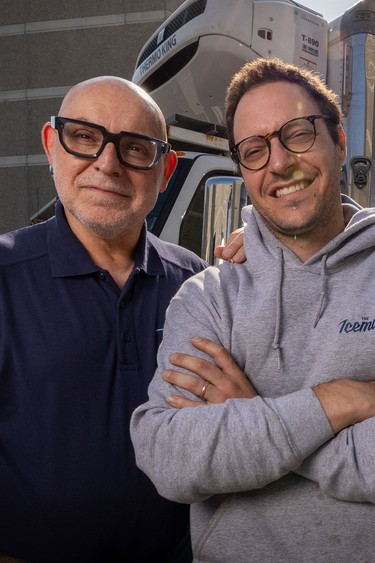

For 40 years, the Silva family toiled in relative anonymity making and delivering ice. That all changed when the biggest rapper in the world came knocking
Article content
It is hard to pinpoint the exact date John Silva decided to name the ice company he started out of his parents’ variety store in downtown Toronto the Iceman, but his path from inspiration to incorporation was abundantly clear.
Whenever he would pull up in his truck, say, to a restaurant, gas station or hotel with his latest ice delivery, someone would blurt out some version of “The iceman is here” or “Are you the iceman?”
Article content
Article content
Advertisement 2

Article content
“It was always iceman-this and iceman-that, so I got the name from there,” he said.

Posthaste
Article content
Despite niche celebrity status, the Iceman toiled in relative anonymity for the better part of 40 years, making, selling and delivering ice to street festivals, concert venues, hotels, restaurants, food processing companies and construction giants throughout the Greater Toronto Area.
In other words, Silva was plenty busy before Drake briefly entered his life, not to mention his ice distribution centre, dressed as an Iceman employee in July 2025.
Article content

The international rap icon picked up a clipboard and a tape measure and measured an ice block. He heated some food in the lunchroom microwave, rapped a few lines and then drove off behind the wheel of an Iceman delivery truck, turning laps on nearby streets before he parked the vehicle and disappeared into the night.
The 58-minute video livestream was part of an elaborate, months-long promotional run-up to the May release of Drake’s latest chart-topping album called, yep, Iceman.

We apologize, but this video has failed to load.
Drake’s musical appeal may be a mystery to those with a taste for classic rock, but he is a modern John, Paul, George and Ringo to many. His superstardom is global and it can make the kids go a little loopy, as evidenced by the foolhardy bunch who risked life and limb pursuing him in the ice truck on foot and bicycle through the streets of Toronto, in addition to the billion-plus Spotify downloads the songs from Iceman have accrued to date.
Article content
The outpouring of love for Drake has led wags to declare it the Summer of the Iceman. Of course, every summer for the past 39 years has been the Summer of the Iceman for the original Iceman, one who earned a pretty penny as a teenager working weekends as a drummer in a Portuguese wedding band.

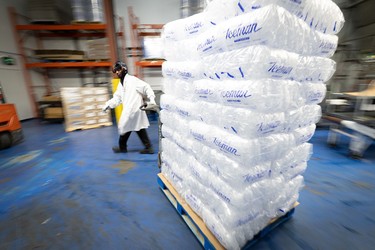
Silva is not a “big rap guy,” but he is an ice guy consumed year-round by the affairs of a family business that has a factory in the suburbs capable of producing 250,000 pounds of ice per day. The Iceman does about $15 million in revenues annually and the company is currently building a $7-million ice plant that will more than double its production capacity in the near term, while leaving room to add even more capacity long term.
“We have a lot of stuff going on,” Silva said.
Typically, it is the sort of stuff that does not involve Drake. On the night of the livestream, the Iceman’s internet server crashed due to a surge in traffic. Its voicemail was flooded with messages from fans, presumably calling in the hopes that a certain rapper might answer.
He did not, but the phone has kept ringing at Iceman headquarters, with most callers looking to buy ice. It is a business grounded upon the principles of impermanence. Ice gets made, ice melts, a fleeting property not unlike the nature of fame. One day you are on top; the next day you are driving an ice truck for a living.
Article content
What has been really cool … is that Drake put us on an international stage, and we’ve been able to sort of stand on the shoulders of his celebrity
Jake Silva
But both Drake and the Iceman have shown remarkable staying power in their respective professions.
Silva’s eldest son, Jake, joined the company 15 years ago, and he works closely with his 64-year-old father. It is hard to gauge the financial impact of the business’s brush with an international celebrity, he said, but it has created a previously unimagined revenue stream, selling $300 Iceman jackets, $75 hoodies and $60 t-shirts online.
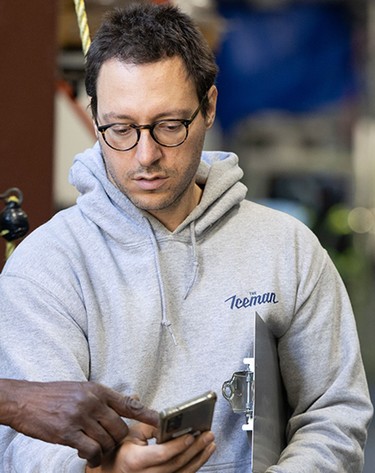
“People started calling us from all over the world asking for our merch, but we are in the ice business, not the merch business, and so at the time we didn’t have any merch to sell,” he said.
They have since sold 300 Iceman jackets and about 500 t-shirts. There is a loose idea to do another run of jackets come fall, but the younger Silva has not had time or energy to give it much thought yet. Summer is the high season for ice, not Drake-related side hustles.
“Our core customers might be Drake fans — I don’t know — but I don’t think that weighs into their decision-making in terms of who is going to provide them with ice for the season,” he said.
The confluence of a Toronto legend and a small Toronto business of the same name was a “match made in heaven,” David Soberman, a marketing professor at the Rotman School of Management, said.
Article content
“Drake has been really quite brilliant in the way he does things, and this is really smart because it is taking product placement to a whole new level,” he said.
Soberman has some suggestions for the Iceman to squeeze some additional nickels out of its Drake connection.
First, hire a hungry, young, business school grad and task them with doing a deep dive analysis of the livestream shoot to look for ways, beyond hoodies, to monetize and merchandise the Drake moment, then give them a 12-month contract to sell as much Iceman-branded stuff as humanly possible.
His other suggestion would be to consider expanding the ice business into new territories, leveraging the company’s elevated profile.
“Drake is one of the two or three biggest pop music stars in the entire world,” he said. “The benefit of something like this is not necessarily in terms of massively tripling or doubling your existing business, but it is about creating opportunities.”
The Silvas were already planning for new opportunities prior to getting a phone call, more or less out of the blue, from Drake’s people.
Canadians enjoy cold drinks, purchasing about $86.5-million worth of ice at retail in 2025, with 40 per cent of sales coming in July, August and September, according to Statistics Canada. The average American buys four bags of ice a year, typically between the Memorial Day weekend in May and Labour Day, according to the United States Food and Drug Administration.
Article content
However, the ice cubes bobbing around in cocktails are just the tip of the statistical iceberg. What the government numbers do not account for are things such as hummus. Industrial-scale hummus producers add ice to the hummus mixture, thus ensuring a smooth finished product.

Agri-businesses and independent farmers pack produce in ice for transport, and when outdoor temperatures creep above 25 C, construction companies add ice to cement-mixing trucks to prevent the cement from curing en route to the job site.
Food processors and construction companies account for more than 50 per cent of the Iceman’s business. In short, ice abounds, including in condominium towers being built.
But the annual spike in demand for it during the summer triggers an equally annual and predictable industry-wide crisis.
“Every summer, there is a shortage of ice,” Jake Silva said.
That is true in Toronto and across the northeastern United States. The players will sell to one another at wholesale prices when one company has surplus ice and another has a shortfall and an order to fill. But that’s not ideal.
“It is a lot more economical for us to make our own ice,” Silva said.
In the big picture, the demand for ice tracks population growth. More people mean more people buying ice, as well as more demand from hummus businesses, those building roads and concrete towers and so on. Hence, the Iceman’s decision to invest in a new plant, since “somebody has to make ice,” Silva said.
Article content
The old plant is in an industrial park near a highway ribboning across the top of Toronto. Two Iceman trucks were parked in the loading bay on a hot, early August morning. Their drivers sought relief in a sliver of shade near the vehicles.
Article content
Once upon a time, they said an Iceman truck was just another truck in a traffic-clogged city. These days, locals are liable to wave, smile, occasionally take photos and generally betray some flicker of a recognition when an Iceman truck rolls past, a refreshing change from the disinterested, occasionally irate Toronto driver look the ice guys had been accustomed to.
“The Drake thing has been great exposure for the company,” Evan Wheatley, a driver, said. “People love seeing the trucks.”
The Silvas have 50 employees. As far as family companies go, theirs reflects a harmonious working relationship in that father and son work closely, but have completely different roles within the company.
John is a natural salesperson, with 40 years’ worth of customer relationships to lean on, which could explain why his phone is constantly pinging. His son works on the production side and is overseeing the planning and construction of the new factory.
Silva has another son, Jordan, who is a wig master and hair stylist with the Canadian Opera Company, while the boys’ mom, Josie, is retired and spends her summers in Portugal, wanting nothing to do with a business that does not stop from May to September.
Article content
On that note, John and Jake appeared remarkably fresh-faced and suitably attired in Iceman-branded clothing following an August long weekend where any plans they may have had were derailed by an iceman’s worst nightmare: one of the icemakers broke down.
If there is a truism about ice, Jake Silva said, it is that it is a hard substance, and it “breaks stuff.” Much of his job involves fixing that stuff.
If there is another truism about ice, it is that not all ice is created equal.
Article content

Ice is regulated as a food product north and south of the border. Iceman is one of 11 Canadian companies belonging to the Canadian branch of the Florida-based International Packaged Ice Association, which has 400 members and a mission to “drive growth” and uphold the highest safety standards.
There is good reason for this: lead, bacteria and all kinds of nasty stuff have been detected in ice by university researchers over the years, including in a 2016 occupational and public health study by Toronto Metropolitan University that examined ice samples from 40 Toronto restaurants. Close to eight per cent of the samples contained bacteria.
Every bag of ice that rolls off of the Iceman assembly line begins with a single ingredient: City of Toronto water. The ice is screened by a metal detector and then gets mixed and turned by a corkscrew-shaped device known as a “snow reel.”
Article content
The reel weeds out excess snow and ice slivers from each batch of ice, enhancing overall ice quality, since, as Silva explained, ice should emerge from a bag in cube form, not in a frozen block that requires being slammed on pavement before being deposited in a cooler.
“Having good cubes is a detail that we try and pay attention to,” he said.
The temperature inside the factory is kept at 11 C. That’s cold, but not so cold that the younger Silva can’t tour the place in a pair of shorts, sneakers and an Iceman hoodie. His father was dressed more for sales calls — long pants and loafers. Both outfits spoke to the chill nature of the family’s business.
“What has been really cool, and I don’t say this lightly, is that Drake put us on an international stage, and we’ve been able to sort of stand on the shoulders of his celebrity and ride the wave of this project that he is working on,” Jake Silva said.
Presumably, at some point, that wave is going to peter out, but the original Iceman is not going anywhere.
“I don’t see myself ever retiring,” John Silva said. “What would I do? I love my job; I work seven days a week.”
• Email: joconnor@postmedia.com
Article content
How Drake’s Iceman helped Toronto business to stardom
2026-08-19 16:57:56