
For much of our history, Canadians have worried about national unity. We may be tempted to do it again.
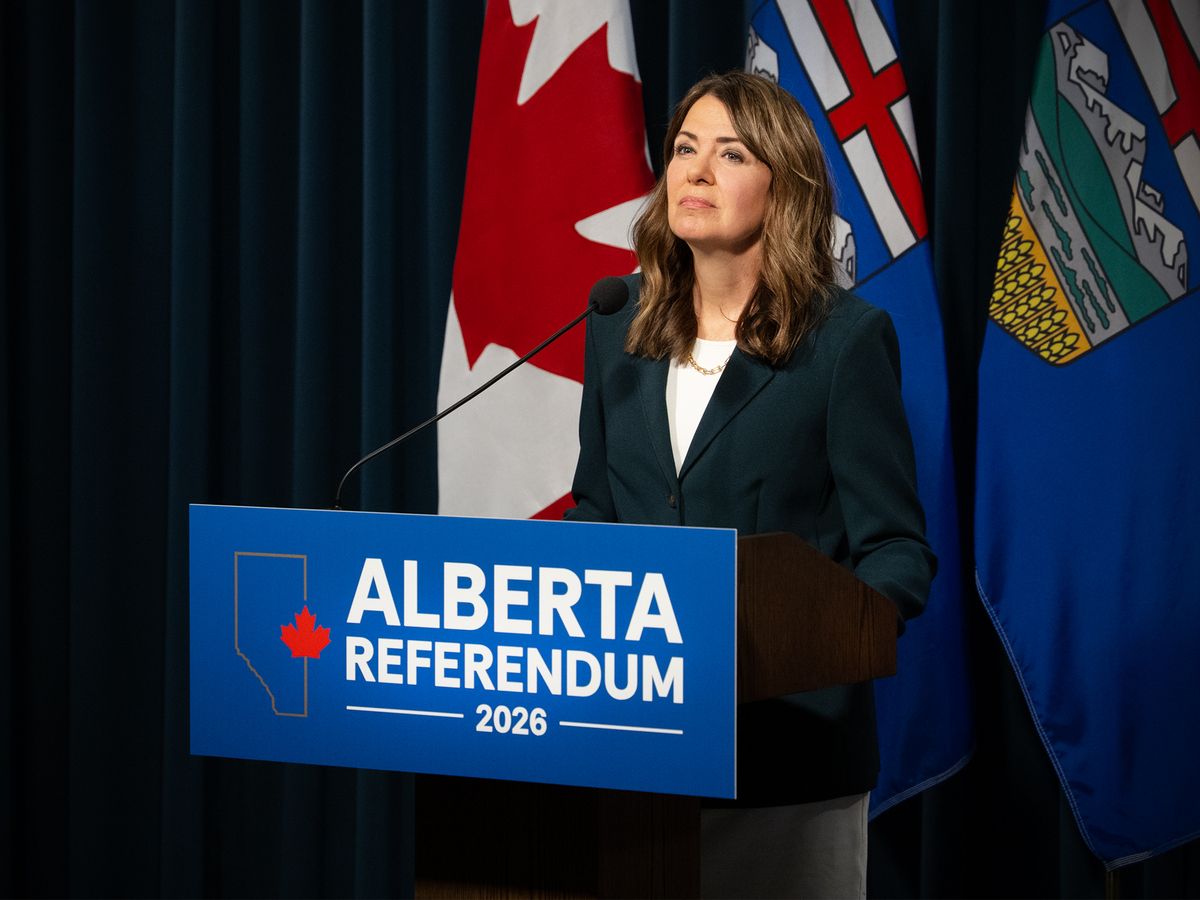
Alberta will vote this October on whether the province should remain in Canada or whether its government should begin the legal process leading to a future referendum on separation. Meanwhile, the separatism discussion remains part of the political landscape in Quebec.
Canadians are entitled to debate these questions. But our governments are equally obliged to recognize that this is an exceptionally bad time for Canada to become absorbed in another bout of constitutional navel-gazing.
We face challenges to our sovereignty and prosperity more serious than anything we have experienced in generations.
For roughly 40 years, Canada’s economic strategy has been built around increasing integration with the American market. Beginning with the Canada-U.S. Free Trade Agreement in 1989, we organized much of our economy around the assumption that the United States was a reliable trading partner that would respect its commitments.
For roughly 80 years, our security strategy has rested on an equally fundamental assumption: whatever our occasional differences, the United States was our closest friend, our principal ally and ultimately the guarantor of continental security. Our militaries cooperated closely in war and peace, deliberately building forces designed to be interoperable.
Both assumptions now require reconsideration.
U.S. President Donald Trump has repeatedly questioned Canada’s sovereignty, mused about making Canada an American state and used the extraordinary economic leverage of the United States against us. The latest breakdown in trade negotiations and imposition of new tariffs demonstrate that the United States is prepared to use economic coercion to extract concessions from Canada.
Our answer must be a national project of unusual ambition.
We need to diversify our trade, remove the remaining barriers within our own country, accelerate major infrastructure and resource projects, build east-west transportation and energy corridors, improve productivity and investment, rebuild our military, secure the Arctic and develop substantially greater capacity to defend ourselves.
In other words, we need to rethink economic policies developed over four decades and security policies developed over eight.
None of this will be easy.
Against that backdrop, what possible national purpose is served by spending the next several years debating whether Canada should be dismantled?
The Supreme Court’s 1998 Secession Reference is sometimes treated as though it created a constitutional roadmap to independence for any province able to assemble 50 per cent plus one of the votes. It did no such thing.
The Court ruled that no province has a unilateral right to secede. It held that only a clear majority on a clear question could create an obligation on the other governments in Confederation to negotiate. Even then, a referendum would have no legal effect by itself, and negotiations would have to respect federalism, the rule of law, minority rights and the interests of all Canadians.
Parliament subsequently enacted the Clarity Act, creating a legal framework for giving effect to the Court’s decision. It provides that the Government of Canada shall not negotiate secession unless the House of Commons first determines that a clear majority has clearly expressed a desire to leave Canada. In making that determination, Parliament may consider turnout, the size of the majority and, importantly, “any other matters or circumstances” it considers relevant.
That last provision deserves particular attention today.
A referendum conducted in an age of foreign interference cannot be judged solely by counting ballots. There is now evidence of attempts by foreign actors to influence the Alberta referendum debate, and separatist leaders have met with officials of the U.S. administration. None of that establishes that Washington is directing the separatist movement, and we should not make claims the evidence cannot support. But neither can Canada be naive about the vulnerability of a referendum concerning the country’s territorial integrity to foreign influence.
At a time when the government of our closest neighbour is openly questioning Canadian sovereignty, Ottawa would be irresponsible not to treat foreign interference in any secession campaign as a matter of national security.
The constitutional principle should be straightforward: before Canada accepts any obligation to negotiate its own dismemberment, the democratic mandate for doing so must be unequivocal, substantial and demonstrably free from material foreign interference.
That does not mean silencing separatists. Free Canadians have every right to argue that their province should leave Confederation.
Nor should Ottawa declare that it would ignore an unquestionably clear democratic mandate. That would be inconsistent with the Secession Reference.
But the federal government need not assist separatism, legitimize ambiguous referendum exercises or allow provincial political manoeuvring to dictate Canada’s national agenda.
Indeed, Alberta’s October question does not itself ask Albertans to choose independence. It asks whether the government should begin a process leading to a later binding referendum, and Elections Alberta expressly describes the result as non-binding. There is therefore nothing for Ottawa or the other provinces to negotiate.
But even a prolonged debate over Canada’s possible breakup would impose costs at precisely the wrong moment. It would consume political attention, unsettle investment and weaken the sense of national purpose we now urgently need.
The federal response should be courteous, firm and brief: debate whatever you wish, but the Government of Canada is governing Canada.
And Canada has work to do.
We have a country to strengthen, an economy to rebuild for a less dependable world, alliances to diversify, armed forces to restore and a sovereignty to defend.
This is not the moment to ask how we might divide Canada.
It is the moment to decide how we make Canada strong enough to meet what is coming.
John Manley is Chairman of Jefferies Securities and the former Deputy Prime Minister and Minister of Finance of Canada.
John Manley: This is no time to break up Canada
2026-08-28 17:32:36