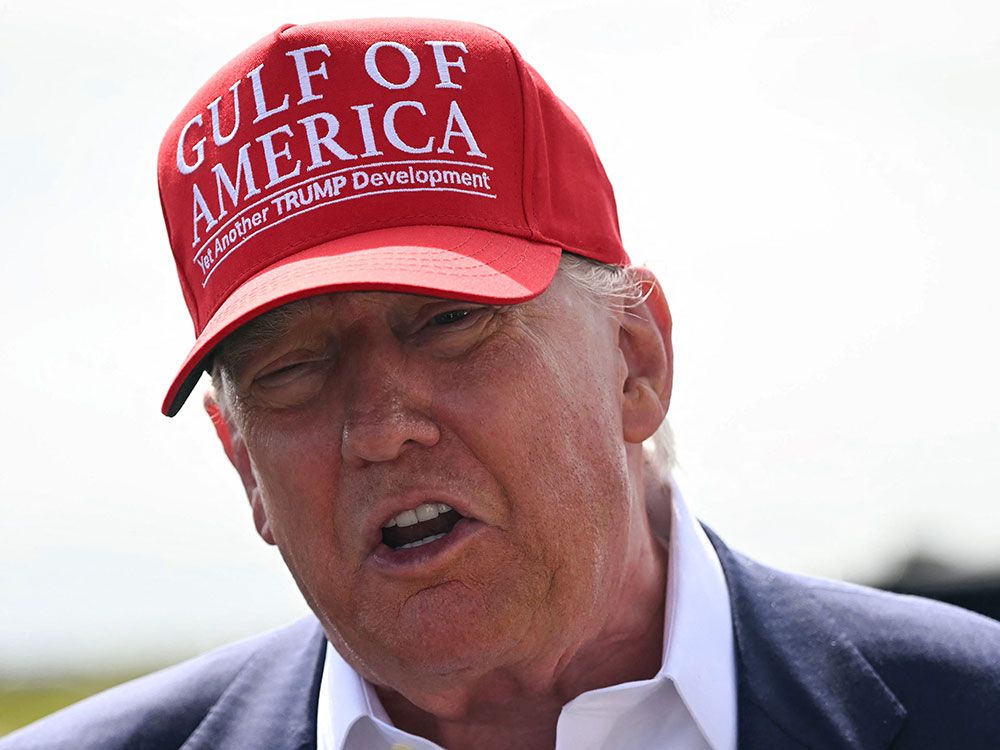
Canadian businesses are once again scrambling, trying to interpret the latest trade edict from U.S. president Donald Trump, who sent a letter late Thursday threatening
Canadian imports with a 35 per cent tariff.
Among the immediate questions was whether a raft of goods and services that are compliant with the existing trade deal with Mexico and the United States will remain exempt from new tariffs, with some businesses interpreting the latest edict as a worst-case scenario as the two countries negotiate to agree to new trade terms by a self-imposed deadline of Aug. 1 (extended from July 21).
“To be frank, the future of U.S. trade policy is as clear as mud,” said Avery Shenfeld, chief economist at CIBC Capital Markets. “That’s inevitable when White House decisions seem to be based on the whims, and mood, of one particular man, and when it’s hard to ascribe changes to a well-articulated American objective.”
Even if the threat is a negotiating tactic by Trump, as some business decision-makers believe, the uncertainty it brings is nevertheless a big concern.
“Having spent months under on-again, off-again tariffs and threats, Canadians already know just how damaging this can be — both to our economy and the relationship we’ve enjoyed with our southern neighbour for decades,” said Candace Laing, chief executive of the Canadian Chamber of Commerce.
“If the U.S. chooses to pay more for the products they already buy from us, it will be Americans who will bear the final cost, through inflated prices and disrupted supply chains. Meanwhile, the imposition of a blanket-rate tariff on Canadian goods will hit our manufacturers, exporters and workers, further elevating the uncertainty that is damaging the most productive trade relationship our two countries have ever had.”
She said the business association is hopeful that the two governments will continue talks in good faith and behind closed doors to reach “a real and reliable” economic and security relationship.
“Only this will benefit businesses and workers in both countries,” Laing said.
Dennis Darby, chief executive of Canadian Manufacturers & Exporters, said the latest threat from the U.S. to increase tariffs is further undermining stability for manufacturers, workers, and cross-border supply chains in Canada and the United States.
“This unjustified threat creates more uncertainty for the very job creators in both countries who drive our shared economic prosperity,” he said in a statement.
He referred to the development as a “setback” and said it raises serious doubts about the U.S. administration’s ability to negotiate in good faith.
“An agreement is urgently needed to remove the needless costs and instability being imposed on our integrated manufacturing sectors,” Darby said.
Sal Guatieri, a senior economist at BMO Capital Markets, said if goods compliant with the
Canada U.S.-Mexico Trade Agreement (CUSMA)
remain exempt from new tariffs, the threatened increase for some goods would result in a slightly larger, though still shallow, economic contraction, which the bank is already forecasting.
“If we lost the exemption, we are talking about a much more severe outcome,” he said.
Jon Levin, a veteran corporate lawyer at Fasken Martineau DuMoulin LLP, said clients he has spoken to largely view Trump’s letter as a negotiating tactic to pressure the Canadian government in its discussions with the U.S. so reactions are muted. But some are now questioning whether Canada’s Prime Minister Mark Carney gave up a potentially powerful bargaining chip last month by abruptly abandoning
Canada’s digital sales tax
, which would have affected large U.S. tech firms.
“There is a view that for the Trump administration to make (the 35 per cent tariff) announcement after Canada announced it would abandon the digital services tax demonstrates that there is no point in making concessions that are not part of an overall deal,” he said. “Rather, it would have been better if Canada had announced that it was deferring the start date of that tax pending the outcome of trade negotiations with the U.S.”
William Pellerin, a partner in the international trade practice at law firm McMillan LLP, said Canada has been seeking a broader defence and security pact, with the hope of returning to wider trade talks later this year or next. However, the Trump administration continues to tie any progress to two main sticking points — Canada’ supply management system and concerns over fentanyl making its way into the country through Canada — while showing little evidence to support the latter.
“There is still a window, albeit just a few weeks, for the two sides to reach an agreement,” Pellerin said.
The prospect of wider talks down the road to renew the CUSMA agreement with the U.S. and Mexico suggests Canada should carefully balance what the country is willing to give up and how hard it’s prepared to push back in the current trade negotiations, said Shenfeld, the CIBC economist.
“If (CUSMA) isn’t renewed in 2026, all of our exports could see double-digit U.S. reciprocal tariffs if they haven’t been overruled by the U.S. courts,” he said in a note to clients. “That’s another reason to not go full elbows up now, or give the U.S. everything it wants at the negotiating table. We’ll need to save some cards for the next hand, as we get to work on the (CUSMA) renewal.”
• Email: bshecter@postmedia.com
Bookmark our website and support our journalism: Don’t miss the business news you need to know — add financialpost.com to your bookmarks and sign up for our newsletters here.
Trump's new tariff threat hikes uncertainty for Canadian businesses
2025-07-11 17:52:36