Every year hundreds of thousands of Americans migrate north for the fishing and the friendship, creating bonds not even politics can put asunder. Here are their stories
Article content
Gary Pullen swore that he would retire from farming when he turned 75, so he sold off all his farm equipment to uphold his pledge, thereby freeing up the now-77-year-old to do other things, such as talk about fishing.
Article content
Article content
As a farm kid growing up north of Peoria in Illinois corn country, he often fished in the creeks when his father didn’t have him doing chores. But it was after the sun went down and he tucked into the latest issue of Sports Afield magazine that his childhood imagination was fired by depictions of a fishing paradise to the north penned by Jason Lucas, a pipe-smoking, failed Anglo-Irish novelist who was posthumously remembered as a “bass fishing evangelist.”
Advertisement 2

Article content
Going fishing is a better deal than going on a cruise. Canada is my happy place
American angler Gary Pullen
Lucas has been dead for 50 years, but his sermonizing back then made Pullen a convert about bass as well as other fish, too. So much so that he embarked upon his first trip to northwestern Ontario in 1990 to search for walleye, a large-mouthed, sharp-toothed, pearly eyed creature prized for its tastiness when freshly pan-fried with a dollop of butter.

Top Stories
Article content
Pullen has trip No. 78 to Canada booked for the end of June, and he plans to keep coming back for as long as he stays healthy, is able to drive and can convince his wife or enough buddies who aren’t suffering from this-or-that ailment to make the trek to a part of Ontario where the walleye outnumber the people by a sizable margin.
“Going fishing is a better deal than going on a cruise,” he said. “Canada is my happy place.”
It is arguably the walleye — along with the wilderness, friendships and peace and quiet — that continues to lure many Americans north despite Donald Trump’s tariffs, his comments about Canada being the 51st state annoying the locals and Canadians cancelling or not planning any trips to the U.S. anytime soon.
Article content
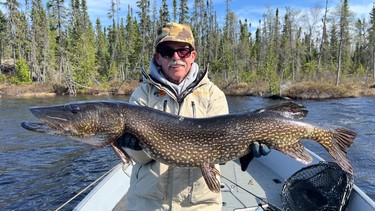
They arrive in a great caravan of pickup trucks that appears around the Memorial Day weekend in May and gradually peters out in September, according to Drake Dill, the mayor of International Falls, Minn.
Article content
“Depending on where these tariffs will or won’t be, or could or couldn’t be, it is all a guessing game, but if Canadians are going to be disincentivized to come and visit us, then they’re not going to come and visit,” he said. “I would say likewise for Americans going the other way, but the one thing that Canada has an abundance of that Americans really, really enjoy is walleye.”
Canadians certainly aren’t going to turn away their American neighbours; they want our fish, we need their business.
“Recreational fishing is a time-honoured tradition and significant economic driver in Ontario, especially for our northern and remote communities,” Ontario Minister of Natural Resources Mike Harris said. “We encourage everyone from Ontario, and beyond, to enjoy Ontario’s world-class recreational fishing.”
His ministry undertakes an extensive survey every five years to assess the economic benefits and social importance of recreational fishing on the province’s 250,000 inland lakes. The 2025 survey has yet to occur and the 2020 survey did not happen due to COVID-19, so the most substantive block of data is from 2015.
That survey’s topline findings were that 321,684 non-resident anglers, the bulk of whom were American, fished in Ontario waters that year and shelled out about $250 million on accommodation, food and fishing supplies while doing so.
Article content
Ninety per cent of the American fisherfolk were male and they averaged 60 years of age. Half said they came to Canada in search of the ubiquitous and delectable walleye, and 80 per cent said they would not have come north were it not for the fishing.
Data from 2024 indicates that 312,092 non-resident, mostly American anglers visited Ontario, so the fish are clearly still biting.
Article content
The Americans catching them are spending more than they did a decade ago to stay in lodges that advertise “American Plan” packages priced exclusively in greenbacks that include all meals, a motorized boat, gas, a fish finder, access to fishing guides, live bait and a roof over their head for about US$2,000 per person per week — all within a few hours drive of the border crossing between Fort Frances, Ont., and International Falls.
Walleye season opened mid-May, so it is still early fishing days yet, but outfitters on this side of the border say Americans are still coming north and are often calling ahead to make sure that they are welcome and to ask whether anything has changed at the border.
The total number of American tourists — anglers and otherwise — making the trek to northwestern Ontario has yet to fully rebound to pre-pandemic numbers, but the overall number of Americans coming to Canada was down 10 per cent in March from February.
Article content
The real “meaningful numbers” in fishing country, however, come from May to September, Gerry Cariou, executive director of the Sunset Country Travel Association, said.
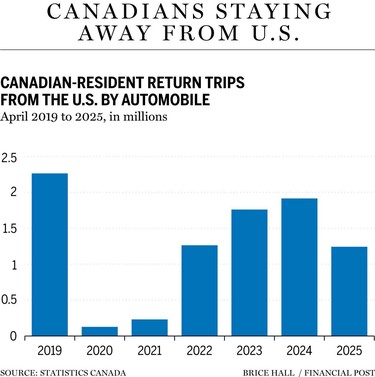
The number of Canadian border crossings by car into the U.S. decreased 32 per cent in March alone, according to Statistics Canada, a sharp drop that has the U.S. Travel Association sounding alarm bells that it could put 140,000 jobs at risk and result in US$6 billion in American tourism industry-related losses by year’s end.
Tradition dies hard
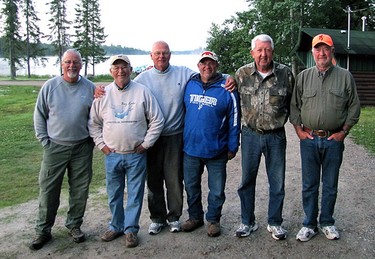
Getting together with a bunch of pals who have known one another forever and relish retelling the same old stories and perhaps generating a few new ones is a cherished rite among American anglers, and the enduring narrative behind the fishing buddy trip to Canada has a history stretching back 100-plus years.
The trips are a key economic driver in an area of Ontario that has been battered by two decades’ worth of pulp and paper mill closures in single-industry small towns, including Fort Frances, which lost its mill more than a decade ago and the 200-plus unionized jobs that came with it.
“We have been struggling to reinvent ourselves ever since, and tourism is a big part of that reinvention,” Andrew Hallikas, the mayor of Fort Frances, said. “We depend heavily on Americans coming up here to fish and hunt.”
Article content
Dill in International Falls can speak firsthand to Canada’s attractiveness among Americans as the former owner of a Canadian fly-in fishing operation he ran with his parents. The base camp was Armstrong, Ont., northwest of Lake Nipigon, and scattered beyond it was a collection of cabins the family owned on lakes without road access.
He earned his commercial pilot’s licence at 18 and he would deliver clients, 90 per cent of whom were American, dockside in a single-engine, Canadian-made de Havilland Otter. His personal favourite fishing ground was north of the Albany River.
“I was fortunate because it is a part of Canada most people never get to see,” he said. “There are plenty of walleye and pike, but the big secret up there is the brook trout.”
The people of International Falls are our friends and that’s not going to change, regardless of what comes out of Trump’s mouth
Andrew Hallikas, the mayor of Fort Frances, Ont.
Dill sold the family business six years ago after his father, a Minnesota state legislator, passed away, and this past November he did what he swore he would never do and ran for mayor of International Falls and wound up winning the election by a landslide.
His entry into politics has led to a friendship with Hallikas, whose family has lived in “The Fort” for three generations. He is known around town among residents of a certain age for being the retired physics teacher who actually made physics fun for his students.
Article content
There is a 40-year age gap between the two politicians, but when the 75-year-old Canadian sits down with the 35-year-old American to talk about the differences between their border towns, which are tethered together by a 100-year-old-plus, 300-metre-long bridge spanning the Rainy River, the only difference they reliably come up with is that their towns happen to be in two different countries.
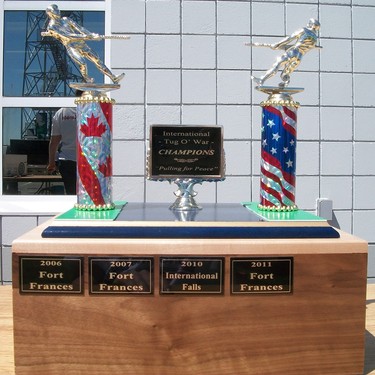
Otherwise, their most pressing mutual concerns pre-Trump were not dissimilar from a lot of other North American small towns, chiefly, how to stimulate economic development, pay for infrastructure, provide new housing stock, stem population losses and convince more newcomers to move to The Fort and The Falls.
Notwithstanding these major challenges, the towns, which have a combined population of roughly 13,000, have always possessed a superpower in comparison, say, to some isolated burgh in the middle of Manitoba, which is their cross-border relationship.
For example, a kid in Fort Frances who wants to play baseball can sign up in International Falls since there is no Little League on the Canadian side of the bridge. Aspiring young soccer players in International Falls play their community soccer in Fort Frances. The two local high schools share a fierce hockey rivalry, and prior to an unfortunate incident involving some bad cases of rope burn, the neighbours held a friendly annual international tug of war known as the Pull for Peace.
Article content
“The people of International Falls are our friends and that’s not going to change, regardless of what comes out of Trump’s mouth,” Hallikas said. “We’ve been friends for over 100 years.”
But what has been tugging at Canadians since Trump’s election is how to express their displeasure with the president without damaging relationships with their neighbours on the other side of the bridge.
Residents of The Fort have historically popped over to The Falls to gas up their cars and pick up groceries, while Americans head the other way for the walleye and Thursday night wing night at La Place Rendez-Vous, a family owned resort/restaurant.
Sarah Noonan, the resort’s owner and a former student of the mayor, has three kids who participate in extracurriculars in International Falls. Like many Canadians, she is ticked off at Trump, and she said that while she has not stopped going to the U.S. for her children’s activities, she has become more “intentional” in her spending while there.
Instead of grabbing lunch, getting gas and throwing a few bags of groceries in the trunk, she cheers on the Little Leaguers and then heads straight home.
“I have to navigate the issue sensitively and look at it through our own business’s lens, but I also need to look at it personally, and sometimes those two viewpoints are going to be in conflict,” she said.
Article content
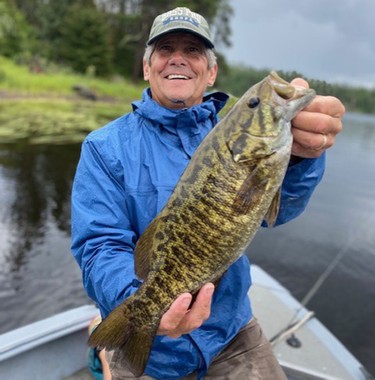
But there was no discernible trace of inner turmoil gnawing at Mark Scheipeter’s conscience as he spoke of his upcoming fishing trip to Ontario. The longtime custom homebuilder in St. Louis, who wound down his own business last summer and now works for a few other outfits, spent a good chunk of his adult life dreaming about going north.
He was always too busy working and too strapped for cash raising kids to splurge on the adventure, at least until a few years ago. This July will mark his third trip to Canada and with the kids no longer “on the payroll” and dear old dad no longer working 65 hours a week, he plans on a lengthy streak of visits.
Scheipeter said he does not pay much attention to politics since life is stressful enough as is, but said Trump’s great contribution to society has been to provide the late-night “comedians” with a steady stream of fresh material.
The trucker’s son loves to drive and he will do the 16.5-hour slog to a lodge near Atikokan, Ont., in a straight shot running up U.S. Highway 53 to the border crossing at International Falls. He also fishes closer to home, but a crowded fishing hole in the middle of Missouri is not the same as being in the middle of a Canadian nowhere.
You guys love your hockey. You guys love your fishing. You guys put up with some pretty crazy weather, and I love going north to be a part of it all
American angler Mark Scheipeter
“With fishing, you are in the moment, and it is so hard to live life these days in the moment because everything is about social media and what you know, what you are going to do next and how you measure up,” he said.
Article content
“But when you go fishing, you are in nature, and you are in the moment, and there’s just something about being in the moment in Canada. You guys love your hockey. You guys love your fishing. You guys put up with some pretty crazy weather, and I love going north to be a part of it all.”
In other words, he is not overly fussed by Canadians cutting back on trips to the U.S., nor is he planning any retaliatory measures, not when there is walleye for the taking.
Article content
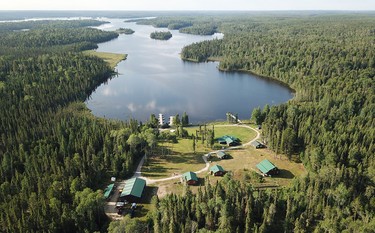
Escape from crazy
A few hours northeast of Scheipeter’s end destination is Wildewood Lodge on Lake Savant in Ontario. The precise history of the lodge is a bit fuzzy, but once upon a time it was founded by a group of Wisconsinites as a wilderness and religious retreat. A guy from Ohio eventually bought out the church group and later sold the lodge to another Wisconsinite, who eventually sold it to the Kerecman family from, you guessed it, Wisconsin.
Andy Kerecman runs the place now, and he was taking a midday breather after a hectic May opening weekend that involved having to inform his 16 guests — 14 Americans and two Canadians — not to arrive early because the lodge was under an evacuation order due to a nearby forest fire.
“There was a giant plume of smoke coming our way and burnt spruce needles falling on us,” he said.
Article content
Fortunately, the wind eventually shifted, the roads reopened and the guests arrived, albeit a day or two late, and then it snowed just to keep things interesting. But what was predictable was that the fish were biting and the (mostly) American guests were happy.
“This is a really special place,” Kerecman said. “Look, I am from northern Wisconsin; there are over 1,300 lakes and it is beautiful there, but Canada offers a true wilderness experience and I don’t think there’s many places still like that in the U.S.”
Article content
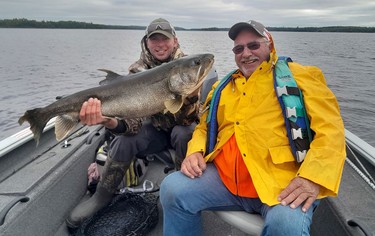
Besides, he said, the fishing in Canada is incredible, which inspired him to tell a story about how he fell in love with Wildewood.
He and his father had come north to go bear hunting, but were wise enough to pack fishing nets for the trip. While bushwhacking along the lake’s border, they caught sight of a “fish back” near the water’s surface. They scooped it up with a net and there it was: a 48-inch northern pike with a 22-inch lake trout in its mouth. A few years later they bought the lodge.
“The fishing here is spectacular,” he said.
The economics of owning a lodge in northwestern Ontario are a little less dazzling. An owner/outfitter has about five months of the year to make money. Kerecman does not have a big enough sample size to draw any hard and fast conclusions — and the pandemic was a wrench in the plan of a completely different kind — but what he can say is that business has been a bit unpredictable.
Article content
Emerging from the pandemic, 2022 was a banner year, 2023 was quieter and 2024 was their best year yet, but bookings for 2025 have been down by comparison. Kerecman does not think that the ups and downs have anything to do with politics, but are more in line with American concerns around inflation, sagging consumer confidence and uncertainty over what Trump may or may not do, especially when it comes to the fallout effects on their jobs.
“Most of our guests have a generational connection to fishing in Canada and they aren’t going to let political tensions between the two countries stop them from coming up north,” he said.
The bulk of Kerecman’s guests are from Minnesota, Wisconsin, Iowa and Illinois, though he will get some outlier bookings, such as a recent couple from Toronto, as well as groups from as far away as California and Texas.
Down in Illinois, Gary Pullen was talking about the good old days, and not in fishing, but generally. The subdivisions of Peoria continue to creep closer to the farm and the annual fishing buddy trips to Ontario have been undergoing a natural process of attrition as the participants grow older.
But what troubles him most is the change in his country’s politics and personality. He is a lifelong Republican. Part of being a Republican, by his definition, means working with people you might otherwise disagree with to find a solution, but there does not appear to be any common ground these days.
Article content
“Trump is a man-child,” he said. “He is disrespectful to everybody.”
Canada is different, he said. He feels as though he is being transported back to a simpler time with a slower pace, friendly people and plenty of walleye when he crosses the border at International Falls/Fort Frances.
“It’s not always about catching fish,” he said. “It is about getting away from the crazy, because there is a lot of crazy these days.”
• Email: joconnor@postmedia.com
Bookmark our website and support our journalism: Don’t miss the business news you need to know — add financialpost.com to your bookmarks and sign up for our newsletters here.
Article content
Fishing draws Americans to Canada despite Trump’s trade war
2025-05-30 15:12:42