So how are those
tariffs working out
for you, Mr. Trump?
From the 90-day backtrack on reciprocal tariffs to the “unsustainable”
trade war with China
, signs are growing that the U.S. President’s trade tactics may not be working out exactly as planned.
Since
Donald Trump
took office just over 100 days ago, the S&P 500 has fallen more than 8 per cent, U.S. consumer confidence has plunged to an almost five-year low and
recession odds
are rising.
Yesterday the president barely
repelled a challenge
to his global tariff offensive in the Republican-controlled Senate and polls show a majority of Americans are against them, Bloomberg reports.
Jimmy Jean, chief economist of Desjardins Group, in a recent note took a look at some of the ways the trade war with China and
Trump’s “tariff house of cards”
are falling apart.
Inflation
Front and centre, the test for tariffs in the American people’s eyes will be rising prices.
China, America’s third-biggest trading partner and second biggest source of imported goods, now faces a 145 per cent tariff from the United States. It has responded with a 125 per cent tariff on American goods.
As the largest source of foreign content for U.S. personal consumption, tariffs on China will erode real disposable income and the purchasing power of American households, especially lower-income households, said Jean.
The Tax Foundation estimates that the duties on Chinese goods — even accounting for Trump’s exemptions on electronics — will cost households US$1,200 a year.
And prices are already rising.
E-commerce shopping sites like
Shein Group Ltd and Temu
face a 120 per cent tariff on many of their products due to the U.S. government’s decision to end the “de minimus” exemption for small packages from China.
According to a survey by Bloomberg, prices on these sites have jumped from 51 per cent to 377 per cent on some items. On Temu’s shipped-from-China goods, taxes exceeded the value of the product. A US$19.49 power strip, for example, attracted US$27.56 in import charges.
Machinery, construction materials and industrial equipment will also become more expensive, said Jean, threatening businesses’ capital spending plans and corporate margins.
Supply chain disruptions
China is not only a major exporter of finished goods, but a “critical supplier” of parts and raw materials, said Jean. Roofing membranes, for example, are made in a small number of Chinese factories and during the pandemic lockdowns, disruption in these supplies led to delays and cost overruns in North American construction projects.
“In the context of what now resembles a quasi-embargo on Chinese imports, many more such stress points are likely to emerge,” he said.
They would include
EV batteries
, pharmaceuticals, for which China supplies 40 per cent of active ingredients used in the United States, and
rare earth elements
(China controls about 70 per cent of global output).
Retaliation
“China holds meaningful economic leverage,” said Jean. In past trade disputes China has targeted politically sensitive U.S. exports such as pork and soybeans, but this time it has broadened the attack, suspending Boeing Co. jet deliveries and cutting imports of oil and
liquefied natural gas
from the United States.
Global impact
The whole world feels the pain when two of its largest economies enter a trade war, and early estimates put the potential hit to global output at up to US$2 trillion, said Jean.
Commodities are already showing the strain.
Copper prices
fell 6 per cent last month — the worst drop since mid-2022 — on signs that the trade war was starting to hurt economies.
Oil sank
16 per cent in April to below US$60 a barrel, partly because of global demand fears.
Most concerning, though, is the blow to the United States’s reputation as a safe haven, said Jean.
Bond yields have surged and the U.S. dollar slumped, “a combination more commonly associated with countries grappling with balance of payments crises,” he said.
China is the second largest foreign holder of U.S. Treasuries, but so far has refrained from using this leverage.
However, “the mere perception that Beijing could shift its reserves leaves investors on tenterhooks,” said Jean.
“Such a move, however subtle, could rattle the very foundations of the global financial system, where Treasuries serve as the ultimate risk-free asset.
Sign up here to get Posthaste delivered straight to your inbox.

Canada’s economy
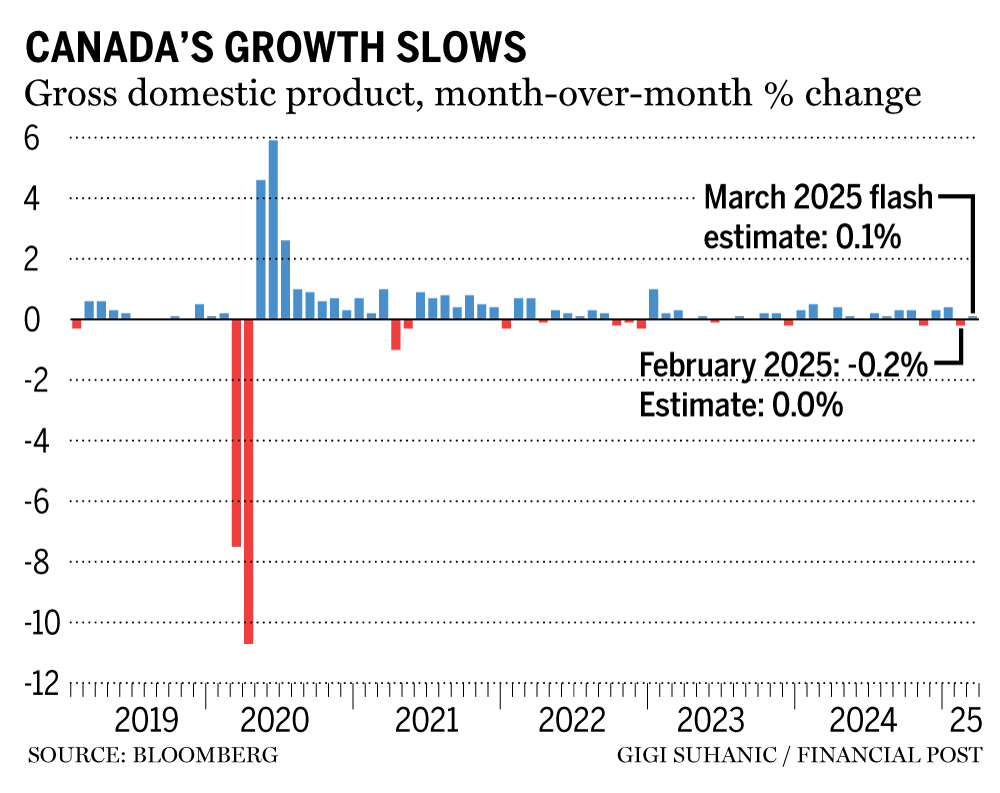
shrank in February and barely grew in March, Statistics Canada data showed Wednesday. A decline in
gross domestic product
of 0.2 per cent followed by 0.1 per cent growth suggests the first quarter will come in below expectations at 1.5 per cent.
The second quarter, when tariffs begin to hit home, is expected be worse. CIBC Capital Markets forecasts that the second quarter will show a “modest contraction,” leading the
Bank of Canada
to cut its interest rate in June.

- Today’s Data: United States ISM Manufacturing, construction spending
- Earnings: Apple Inc., Amazon.com Inc., Cenovus Energy Inc., Cameco Corp., AltaGas Ltd., Thomson Reuters Corp. Bombardier Inc., TC Energy Corp., Canadian National Railway Co., Aritzia Inc., Eldorado Gold Corp.


- Canadian economy headed for recession this year, according to Deloitte outlook
- What is deep-sea mining and why is Donald Trump suddenly so interested in it?
- Will five teams in the NHL playoffs (and a surge of patriotism) mean ka-ching for Canada?

No matter how hard we try, our credit card statements can reveal that many of us have succumbed to impulse buying at some point. While it might offer a temporary thrill, it can throw your financial goals off track and leave you feeling powerless over your money. Mary Castillo looks at why we make impulse purchases and offers practical tips on how to resist temptation.
Read more
McLister on mortgages
Want to learn more about mortgages? Mortgage strategist Robert McLister’s
Financial Post column
can help navigate the complex sector, from the latest trends to financing opportunities you won’t want to miss. Plus check his
mortgage rate page
for Canada’s lowest national mortgage rates, updated daily.
Financial Post on YouTube
Visit the Financial Post’s
YouTube channel
for interviews with Canada’s leading experts in business, economics, housing, the energy sector and more.
Today’s Posthaste was written by Pamela Heaven with additional reporting from Financial Post staff, The Canadian Press and Bloomberg.
Have a story idea, pitch, embargoed report, or a suggestion for this newsletter? Email us at
posthaste@postmedia.com
.
Bookmark our website and support our journalism: Don’t miss the business news you need to know — add financialpost.com to your bookmarks and sign up for our newsletters here
Posthaste: How are those tariffs working out for you so far, Mr. Trump?
2025-05-01 12:10:38