

Oil prices
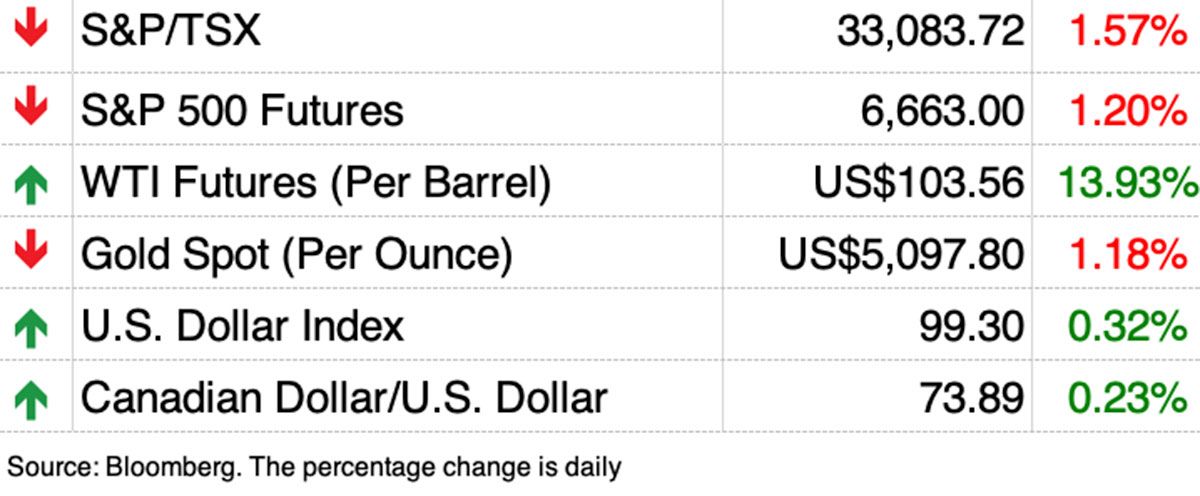
spiked to over US$100 a barrel this morning as the war in the Middle East showed no signs of abating after the United States and Israel first launched the attack on Iran just over a week ago.
G7 finance ministers are holding an
emergency meeting today
with the
International Energy Agency
to talk about potentially tapping global reserves after Brent crude jumped as high as US$119.50, the second biggest increase since 2010. West Texas Intermediate rose to US$102.
Canada is an oil-trading nation so higher prices should be welcome, but economists warn that the negative impacts could outweigh the good.
The oil spike
inflames inflation
and threatens global growth, said Douglas Porter, chief economist at BMO Capital Markets.
“As much as the term
‘stagflation’
has been wildly over-used in recent years, a true oil price shock would indeed increase the risks of stagflationary forces — higher inflation, weaker growth; not a market-friendly combination,” he wrote in a note Friday.
Canada will face some of the same pressures on growth and inflation, he said.
“The oil-producing provinces of Alberta, Saskatchewan and Newfoundland & Labrador will be shielded, but the rest of the country will be dealing with higher headline inflation and downward pressure on growth,” he said.
Energy accounts for six per cent of the consumer price index in Canada so even a temporary jump in oil prices could have a big impact on headline inflation.
“And, unfortunately, investors are gradually coming to the view that the conflict and the upswing in prices may be something more than temporary,” he said.
Even if high oil prices become the new normal the impact on Canada’s real gross domestic product would likely only be modest, said Bradley Saunders, North America economist for Capital Economics.
Oil and gas producers are operating at only three-quarters of their potential capacity, but problems remain on getting the product to global markets because of pipeline constraints.
Because Canada is a net energy exporter higher earnings should boost industry investment and government tax revenues, which would raise household earnings to some extent, he said.
But the
positives to GDP
would be tempered by weaker consumption as consumers’ spending power is eroded by higher gas prices.
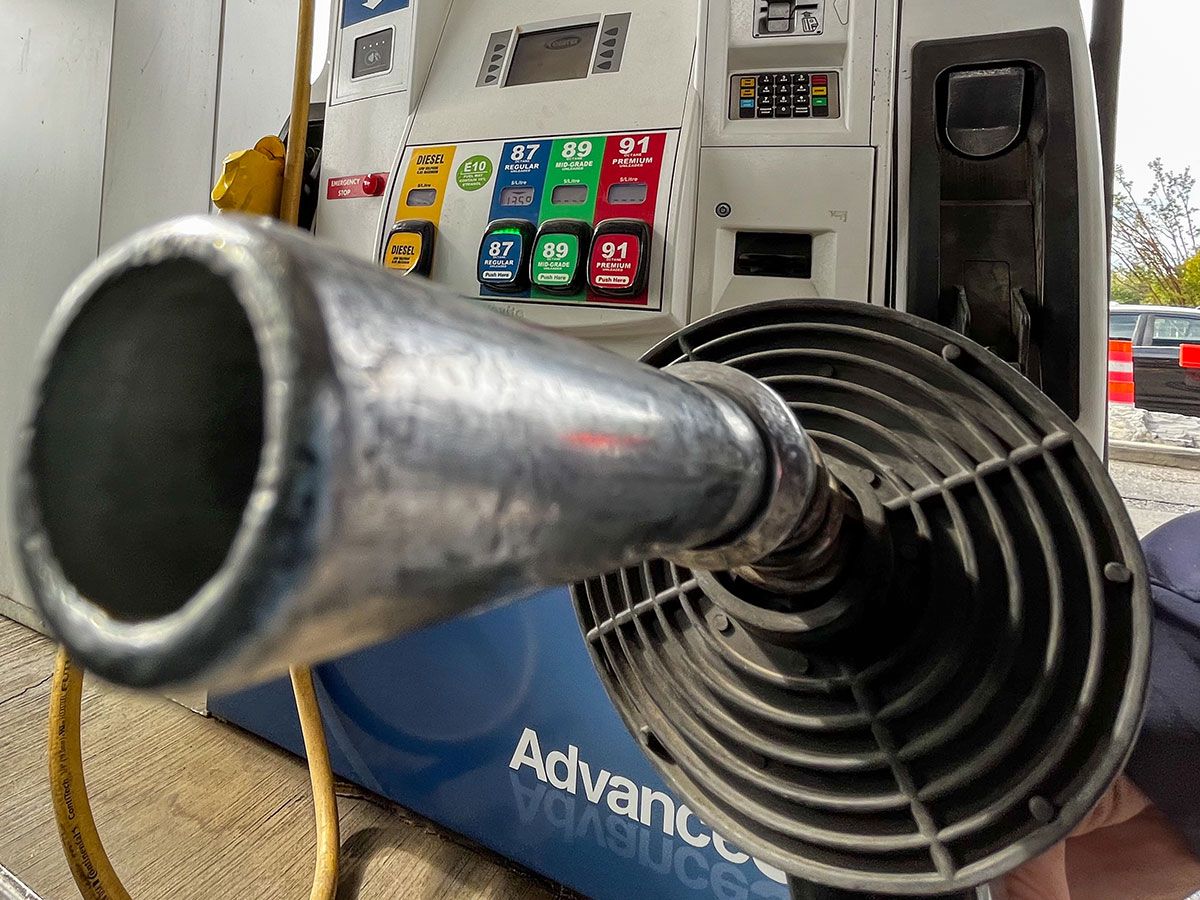
Canadians were already feeling the pinch of the Iran conflict last week with
gas prices
rising as much as 16 cents a litre, and
analysts say the cost of filling up
could soar even higher.
If the conflict continues long enough, rising prices will extend beyond the pumps to consumer goods as shipping costs rise and the cost of transportation such as air travel.
Saunders estimates that if oil averages around US$85 for the next three months before dropping back down, headline inflation will only climb by 0.3 per cent. But if the conflict escalates into a prolonged regional war, WTI would “almost certainly” stay above US$100 as it did after the Russian invasion of Ukraine.
“In that scenario, the direct boost to headline inflation alone would be almost 1%-point and we’d have to factor in larger indirect effects too,” he said.
Inflation pressure is building just as the
Bank of Canada
is already worried about supply disruption from the changing trade relationship with the United States, said Saunders.
Last week the bank’s deputy governor Sharon Kozicki
warned that supply shocks
complicate its mission to keep inflation in check and could lead to
interest rate hikes
even when the economy is weak.
The “silver lining” is that Bank of Canada’s policy rate is already tight which reduces the chance that the central bank will be forced to rapidly increase rates, said Saunders.
Nonetheless, market expectations of a hike this year have increased since the Iran conflict broke out.
Sign up here to get Posthaste delivered straight to your inbox.

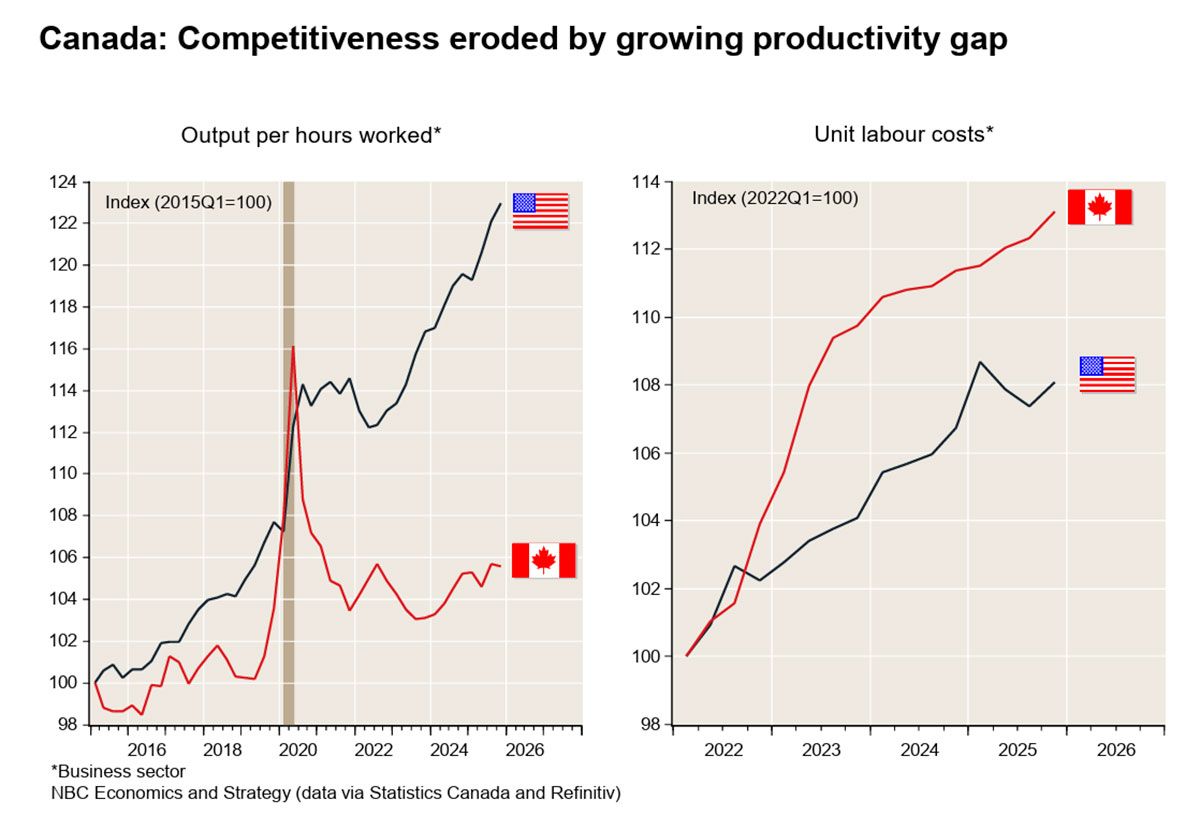
The United States continues to leave Canada in the dust on productivity, the most recent data on both sides of the border shows. The divergence matters not just for output per hour, but for the trajectory of unit labour costs, said Alexandra Ducharme, an economist for National Bank of Canada who brings us today’s “hot chart.”
Robust productivity growth in the U.S. has kept unit labour costs down, but not so in Canada. Here weaker productivity has meant that wage growth has translated into higher costs, said Ducharme.
Since 2022 the growing productivity gap between the two countries has pushed unit labour costs in Canada up 13 per cent compared with an increase of eight per cent in the U.S.

- Earnings: Constellation Software Inc., Hewlett Packard Enterprise Co.


- South Bow confirms open season for new pipeline to the U.S. using legacy Keystone XL permits
- Beer, wine sales fall even more, putting tax revenues on the rocks, but one boozy drink is on the rise
- Howard Levitt: How employers accidentally unionize themselves

With tax season looming, the Financial Post’s tax expert columnist Jamie Golombek offered advice to readers on confusing tax situations ranging from blind trusts to TFSAs versus FHSAs.
Watch the video of this Q&A here.

Interested in energy? The subscriber-only FP West: Energy Insider newsletter brings you exclusive reporting and in-depth analysis on one of the country’s most important sectors.
Sign up here.
McLister on mortgages
Want to learn more about mortgages? Mortgage strategist Robert McLister’s
Financial Post column
can help navigate the complex sector, from the latest trends to financing opportunities you won’t want to miss. Plus check his
mortgage rate page
for Canada’s lowest national mortgage rates, updated daily.
Financial Post on YouTube
Visit the Financial Post’s
YouTube channel
for interviews with Canada’s leading experts in business, economics, housing, the energy sector and more.
Today’s Posthaste was written by Pamela Heaven with additional reporting from Financial Post staff, The Canadian Press and Bloomberg.
Have a story idea, pitch, embargoed report, or a suggestion for this newsletter? Email us at
posthaste@postmedia.com
.
Bookmark our website and support our journalism: Don’t miss the business news you need to know — add financialpost.com to your bookmarks and sign up for our newsletters here
Posthaste: How $100 oil could do Canada's economy more harm than good
2026-03-09 12:08:33