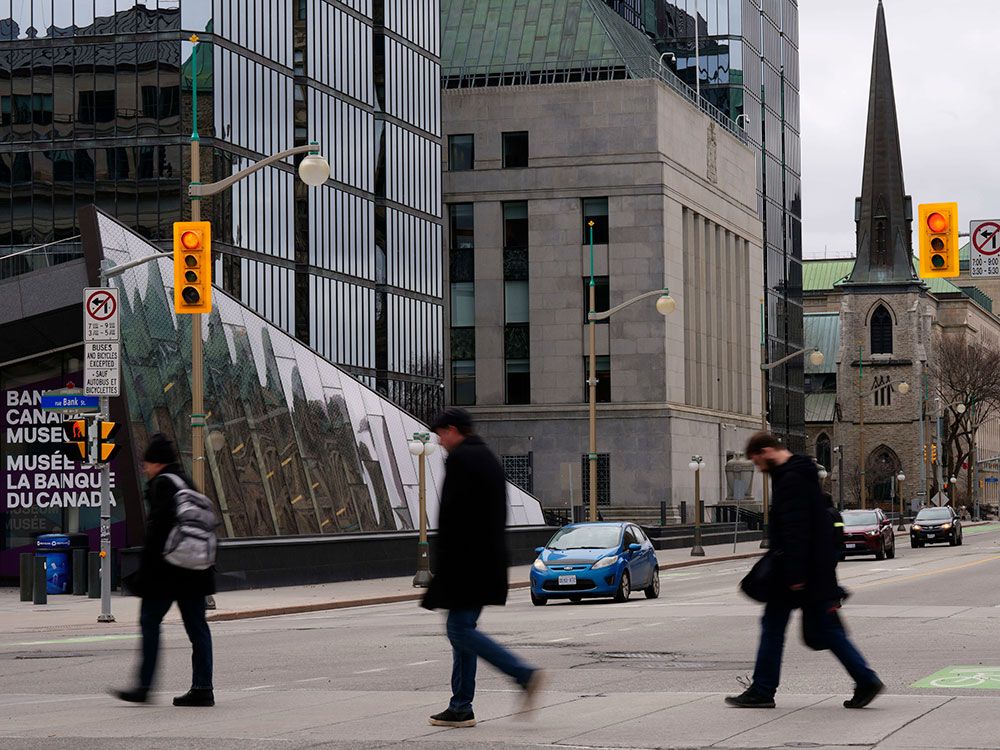
A contraction in the
Canadian economy
in October will dampen bets for a
Bank of Canada
hike in interest rates in 2026, say economists, most of whom expected the economic decline.
Gross domestic product (GDP)
declined by 0.3 per cent in October, after growing 0.2 per cent in September, as 11 out of the 20 industrial sectors followed by Statistics Canada reported declines.
The manufacturing sector, which had led the growth in September, declined by 1.5 per cent in October. A province-wide teachers’ strike in Alberta also had a negative impact on the economy.
Advance estimates indicate GDP increased by 0.1 per cent in November, but this will be updated on Jan. 30, 2026, Statistics Canada said.
“Fourth-quarter growth close to zero”: Capital Economics
The decline in the GDP in October and the modest recovery expected in November suggest markets are “ahead of themselves” in terms of pricing in interest rate hikes for next year, Capital Economics Ltd.’s economist Stephen Brown said in a note on Tuesday.
He said October’s “bad news” didn’t just end with the month and seems to have continued into November, as the advance estimate of a 0.1 per cent growth that month was “the least” he had expected given the end of the teachers’ strike in Alberta.
Overall, he expects fourth-quarter growth, which begins in October and ends in December, to be close to zero.
Growth ‘slightly better’ than expected: CIBC
Despite the decline in October, overall growth in the second half of the year is still “slightly better” than what the Bank of Canada had predicted — one per cent versus 0.75 per cent — CIBC Capital Markets economist Andrew Grantham said.
That’s because of the “surprise” growth in headline GDP in the third quarter, he said.
“This weaker momentum will have to continue into the new year to reawaken talks of interest rate cuts,” he said in a note on Tuesday.
CIBC continues to forecast no changes to the Bank of Canada’s overnight rate in 2026.
“Worst monthly performance since 2021”: Desjardins
The 0.3 per cent decline in October was the worst monthly performance since 2021, Desjardins economist Royce Mendes said, but this wasn’t a surprise as the economy’s strength in the third quarter seemed “unsustainable.”
“Without an outsized increase in GDP in December, the monthly industry data suggest a modest contraction in (the fourth quarter),” he said in a note. “We see this weakness in economic activity continuing into early 2026 before a more durable recovery takes hold later in the year.”
“Conditions stabilizing rather than collapsing”: RBC
The 0.3 per cent decline was a “tick lower” than what
Royal Bank of Canada
economist Abbey Xu expected in the bank’s pre-release expectation, but it was in line with Statistics Canada’s preliminary estimate.
Trade-related uncertainty continues to weigh on export-oriented sectors, but conditions appear to be “stabilizing rather than collapsing,” she said in a note.
“October’s data were also influenced by a handful of one-off factors that should unwind, reinforcing the view that October’s softness does not point to a broader deterioration,” she said.
‘At odds with the labour market strength’: Servus
October’s GDP decline shows that economic activity remains volatile, Servus Credit Union economist Charles St-Arnaud said, and also suggests the recovery from the tariffs imposed by the United States remains “modest and uncertain.”
Going forward, the question for the short-term outlook is whether strong employment is going to lead to improved growth or whether subdued growth will lead to a stalled labour market, he said.
“All this reinforces our view that the Bank of Canada will keep its policy rate unchanged for an extended period, but it remains vigilant and ready to act, if necessary,” he said.
• Email: nkarim@postmedia.com
GDP drop cuts odds of a Bank of Canada interest rate hike in 2026
2025-12-23 15:53:19