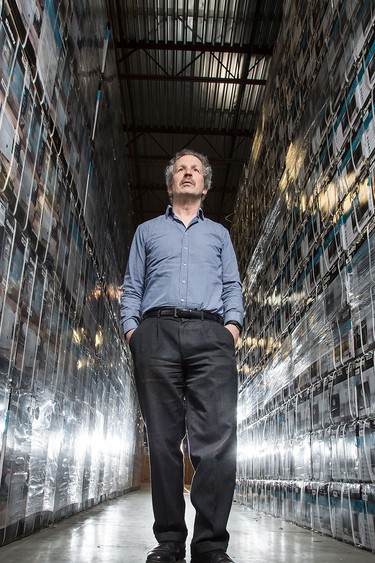

Some are getting crushed and some are getting ahead, but no two trade stories are alike, The Financial Post’s Joe O’Connor finds, after revisiting an unprecedented year with Canadian business people
Article content
Kalid Hedjazi had good news to share concerning his blood sugar level readings, which registered at close to optimal upon testing, meaning the type 2 diabetes he has been living with for 20 years was one less thing the Windsor, Ont., candy importer had to worry about that day.
His chronic illness can be attributed to him having consumed too many treats. Chiefly, American candy bars and other delights that were not available to Canadian consumers back in the 1990s. That was when the entrepreneur happened upon an idea, while grabbing some junk food at a Detroit gas station, that sweet tooths north of the border would love those treats as much as he did.
Article content
Article content
Advertisement 2

Article content
Lo and behold, a small business was born, and with it an occupational health hazard, at least for a guy with a candy habit who also spends hours on end driving around southwestern Ontario in a white cargo van delivering sugary goodies to gas stations and convenience stores.
Article content


Top Stories
Article content
Hedjazi has managed to tame his taste for sweets, but what has been ailing him this past year is something beyond his control: a United States-versus-the-world trade war that has affected a lot of businesses, from potato farmers to fridge makers to sawmill owners, ranging in size from one-person operations, such as Hedjazi’s, to companies with several hundred employees.
He came through the fight largely unscathed in the early days last spring, having loaded up on inventory in anticipation of U.S. President Donald Trump firing his first tariff shot. But by the summer, he was experiencing a serious economic bite and paying a 25 per cent tariff per candy shipment. That increased the cost of each load he brought into Canada from a New Jersey-based wholesaler by $20,000 to $90,000, resulting in some uncomfortable conversations with customers, some of whom he has known for more than 30 years.
“The price of candy basically went up 25 per cent overnight, and it was more or less mission impossible to raise prices in the stores because a 25 per cent hike would have priced the product out of the market,” he said.
Article content
His solution: eat a chunk of the cost. Canada has since ended its retaliatory tariffs on goodies, among other imports, though Hedjazi is still getting hurt since the ingredients that go into making the treats he sells come from countries exposed to U.S. tariffs, as are candies from China.
Overall, it has been a “brutal year,” he said, and easily the toughest since the 2008 financial crisis. What is worse is that when the 63-year-old looks ahead to 2026, all he sees is more trouble on the horizon, which is probably why the three kids he put through university and now work as accountants are encouraging him to pack it in for good.
It was more or less mission impossible to raise prices in the stores because a 25% hike would have priced the product out of the market
Windsor, Ont., candy importer Kalid Hedjazi
“I have too much energy to retire,” he said. “What am I going to do, sit around all day?”
Despite the general angst about tariffs, however, no two trade war stories are exactly alike. Economists are throwing around terms, such as the “K-shaped” economy, to describe how some Canadians like Hedjazi are getting crushed, while others have been getting ahead financially.
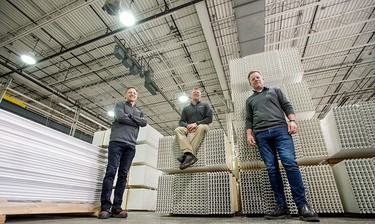
Take Dave Caputo, the co-owner of a sustainable-building material startup, who, when asked how things have been going these past months, cheerily replied, “Great.”
In the face of Trump’s trade war, Palmerston, Ont.-based Trusscore Inc. has enjoyed year-over-year sales growth of 45 per cent in its primary market, which just happens to be the U.S. Come January, the company’s products will be sold in 2,400 retail stores south of the border. Revenues are soaring, nearing $70 million annually, Christmas is coming and with it a vacation somewhere sunny that is “not in the U.S.” for Caputo and his wife.
Article content
Article content
Altogether, life and business have been pretty sweet and the opposite of the “existential” crisis the entrepreneur and his team were preparing for in the weeks prior to Trump launching a trade war on March 4.
Caputo, at the time, was trying to understand what the “rules of the game” were going to be, and he had his sales team pounding the phones to encourage his U.S. customers to load up on inventory. The crisis, when it did come, lasted for about “36 hours” before Trump backtracked and exempted Canadian products that are compliant with the Canada-U.S.-Mexico Agreement (CUSMA) from tariffs, excluding aluminum and steel.
As a result, 85 per cent of Canadian exports reverted back to a free-trade environment for companies with the means to hire lawyers and accountants to complete the paperwork. Following a brief blip, Caputo’s company got back to growing, though Trusscore wasn’t completely immune to tariffs, so it had to get creative.
The company sells flat, plastic components resembling giant pieces of Lego that fit together to form the decking of a cottage dock. The decking is secured to the dock frame by clip strips that used to be made from Canadian aluminum that was exported to a U.S. company for extrusion, then sent to a second U.S. company to be cut into strips and riveted together before being sent to Palmerston for packaging with the dock kit.
Article content
Being made of aluminum, the strips were subject to tariffs, so Caputo, who has a background in tech and in 2017 sold Sandvine Corp., a software company he founded, for $444 million, saw an opportunity to innovate. Using a 3D printer, he and his team developed a plastic clip strip that outperforms the aluminum version, is cheaper to make and eliminated the docking kit’s exposure to tariffs.
“It never would have occurred to us to make the innovation if it wasn’t for the tariffs, and, guess what, it is going to take business away from the two companies in the United States that do the extrusion and the fabrication of an aluminum clip that we no longer need because we have invented a better alternative,” he said.
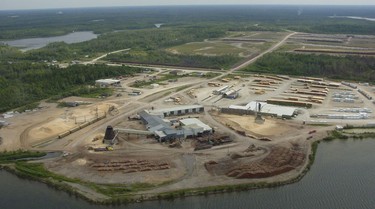
Some products, of course, are beyond innovation. For example, a northern Ontario black spruce forest. U.S. homebuilders have long favoured Canadian spruce, pine and fir for certain housing components, and Roger Lecours, a mill owner near Hearst, Ont., is the third generation of his family to happily oblige those appetites.
He is no stranger to volatility, however, which probably explains why his hair turned white in middle age and why, as Trump set off on a collision course with his country’s largest trading partner, he chose not to make any hasty moves until he saw where the “dust settled.”
Article content
But having clarity has not been of any comfort, since the U.S. hunger for spruce has dropped due to a combination of softwood lumber duties, anti-dumping fees and tariffs that all work out to about a 50 per cent tax on Lecours Lumber Co. Ltd.’s products.
“We used to ship 85 per cent of our lumber to the U.S. and today that number is closer to 65 per cent,” Lecours said. “I had one buyer say, ‘Well, just pay your tariff and I’ll buy your lumber; it is as simple as that — just bite the bullet.’ But there is no logic to biting the bullet.”
He has attempted to strike a balance by increasing his prices, but lumber is sold on a commodities market, so if no one is willing to pay the asking price, the mill gets stuck holding onto the wood, potentially selling it at a loss or scrambling to find domestic buyers that are currently in short supply.
“The situation has become a real test of nerves,” he said.
Article content
For now, and for next year, Lecours said the mill remains on solid financial footing. If he learned anything from his father, Ben, it is that when times are good, you best be socking away money for when times are not, such as now.
U.S. housing starts are down six per cent in August compared to the year before, according to the U.S. Census Bureau and U.S. Department of Housing and Urban Development, and West Fraser Timber Co. Ltd and Domtar Corp. have both announced mill closures in recent weeks.
Article content
Lecours employs 212 people, and his biggest headache prior to Trump 2.0 was always hunting for more workers to keep pace with U.S. demand.
“Our concern is not for 2026; it is more long term,” he said. “A storm cannot last forever, but if things don’t change …”
Change may not be in the cards, Joseph Steinberg, a professor and economist at the University of Toronto, said. He described the current trade relations between Canada and the U.S. as having settled into a “steady state equilibrium.”
One game changer that could potentially upset the balance is the CUSMA talks set to reopen in 2026, but those talks could conceivably go nowhere for another decade before the current deal expires. Another potential game changer, he said, is a case before the U.S. Supreme Court challenging the legality of some of Trump’s global tariffs.
Striking the tariffs down would not provide Canadian steelmakers, aluminum producers and forestry companies with any relief since they fall under Trump’s national security orders, but it could help make life more manageable for smaller players, such as the candyman in Windsor.
Steinberg said the big elephant in the room for the Canadian economy is the continued health of a U.S. economy that is being propelled by the surge in artificial intelligence investment.
Article content
“I don’t want to use the term ‘bubble,’ but if that investment suddenly turns off, and the U.S. economy takes a turn for the worse, it is going to drag the Canadian economy down with it,” he said.
Steinberg said bolstering Canada’s economy for whatever shocks lie ahead requires Prime Minister Mark Carney to borrow a page from his major projects office playbook and slash red tape for projects and companies, big and small, while encouraging the government to get out of the way and let the “market” decide what works and what does not.
He also recommends cutting corporate taxes and ensuring that whatever red tape remains is transparent and easy to understand so that businesses can navigate through it without hiring a bunch of lawyers.
“Right now, if you have a big project, where you’ve got the ear of the prime minister, and they believe that this is something that ought to be done, you can skip through all the hurdles,” he said. “But that’s not true for most businesses; you have got to go through all the hoops and whether you’re going to be able to get over them or not is not often all that clear.”
That divide is why the K-shaped economy term is becoming more mainstream. Adam Fremeth, a professor at Western University’s Ivey School of Business in London, Ont., offered a handy primer on how the alphabet relates to graphing the economy, beginning with the letter “V.”
Article content
He said a V-shaped economy reflects a situation where things collectively go down the tubes for all Canadians and rebound just as quickly. A “U” signals a more gradual decline, followed by some wallowing at a recessionary bottom before a gradual recovery. But a “K” stands for an economy that is headed in two different directions, which is what Canada is looking like right now.
On the plus side, the Big Six banks, which spent 2025 issuing loans to big investors, executing trades and managing wealth, reported bumper fourth-quarter results, capping a bumper fiscal year born on the back of capital markets that dipped at points, but did not seem fazed whatsoever by the tariffs.
Insurance companies also did well, as did mining companies and the oft-battered entertainment sector, which has benefitted from millions of Canadians spending their tourism dollars at home rather than in the U.S.
But it has been a rough year for manufacturing, autos, trucking and warehousing, as well as for most folks at the lower end of the economy, including the one million Ontarians who visited a food bank between April 2024 and March 2025.
“Not only are we seeing these divergences by sector, but there are divergences regionally,” Fremeth said. “We are seeing reasonable growth in Alberta and Saskatchewan of two per cent or over two per cent (gross domestic product), but on the other side you have Quebec, New Brunswick and Ontario, all well under one per cent GDP growth.”
Article content
Manitoba, meanwhile, is kind of limping along, but farmers in potato country can’t stop talking about the year’s bumper harvest. Wayne Rempel, chief executive of Kroeker Farms Ltd., has been farming for 40 years and he does not recall ever seeing anything quite like what’s been happening this year.
“The stars just lined up,” he said. “The weather was good, not too warm, but warm enough, and we had timely rains.”
Article content

The result was a once-in-a-generation crop and a business problem unrelated to tariffs. Dealing with the weather, good or bad, is simply part of the gig of being a farmer, though back in February, it was Trump’s unpredictability that was keeping the CEO awake at night and on the phone daily with his U.S. customers, which account for about 70 per cent of his sales, to offer assurances that the tractor-trailers full of spuds would keep rolling south.
Rempel’s promises cost the company $200,000 in March prior to Trump pulling back on his tariffs. At the time, he and his colleagues were deep into brainstorming sessions to figure out what potentially could be done if Trump did not reverse course.
Winkler, Man., is a great spot to live, but it is a long way from either coast, so looking for buyers overseas did not make sense. Neither did leapfrogging the U.S. and selling to Mexico in the near term, especially since that would require cultivating a taste for potatoes among a traditionally maize-loving culture.
Article content
Had the U.S. tariffs stuck, they would have been a massive problem to overcome. But the actual test has boiled down to possessing an embarrassment of riches — in this case, potatoes.
“Our harvest was up 10 per cent, which may not sound like a lot, but when everyone is up 10 per cent, that is a big pile of potatoes,” Rempel said. “We often say a five per cent surplus creates a 25 per cent price drop.”
In short, there is no tariff to pay, but there are a whole lot of potatoes that need selling.
“Prices come and go, and we are used to the fluctuations in weather and the market, and the biggest concern going forward is still the tariff, or the threat of the tariff,” he said.
Profit margins in potato country tend to run in the five per cent to 10 per cent range depending upon the crop, and even a modest tariff risks putting some farmers out of business.

Bigger tariffs are what’s on Jim Estill’s mind. The serial entrepreneur and chief executive of Danby Products Ltd., a Guelph, Ont.-based appliance maker that has been around since 1947, had an idea during those early days last winter to perhaps fight metaphorical fire with fire by identifying U.S. products that he could make in his Canadian factory to try to knock the American stuff right off of the shelves.
Article content
That has not happened just yet, and his company has taken its share of hits, with tariffs on its U.S. exports clocking in at around the 50 per cent range. Sales in the U.S., which account for 60 per cent of Danby’s sales, are down 40 per cent.
Estill has not had to lay anybody off, but he is not hiring and he is not replacing employees who leave unless they are key to the operation. A multi-million-dollar plant expansion he was planning is on hold indefinitely and his prediction for next year is for more of the same.
“I call it battening down the hatches; we are just being highly conservative in terms of any spending,” he said.
The one silver lining — though it’s not much of one — is that his competitors are all suffering as well. But it is consumers who are going to wind up paying for the trade war at retail. The appliance industry is a massive, globalized supply chain beast, and nowhere in the chain is a fridge getting built top to bottom in North America from parts solely made in North America, so every fridge has tariff exposure.
“Where does a fridge compressor come from?” Estill said. “Where do the casters come from? I guess we could figure out how to make compressors here, but would the consumer then mind paying $2,000 for a bar fridge?”
Article content
For the record, he said consumers would mind, so he’s predicting the arrival of a “new equilibrium.” The tariffs will work their way through the supply chain, and the chain will be somewhat reconfigured to include countries other than China, where most fridges get made, and products will continue to be sold. Perhaps even a Danby fridge, which has a lower price point than more deluxe models sold by the Whirlpools of the world.
“There’s a characteristic we all have to think that the crisis we are in is the worst of times,” he said. “Remember when COVID-19 started? We weren’t sure what was going to go on and whether we were ever going to be able to go outside again, but we got through it, so I’m not thinking this is more dire than what has happened in the past.”
In other words, even when the chips are down, it is good to be optimistic.
Kalid Hedjazi is not much for chips anymore, let alone candy bars, but he can relate to what Estill is saying. After having spent a day driving around and selling candy for barely-break-even prices, he took a morning off to babysit his grandson. Over the holidays, the Hedjazi clan is going to Chicago for a family wedding, and in a few years, when he is ready, he will retire, but Trump is not going to be the one to tell him when.
“I made less money this year than last year, but I am still OK,” he said. “On my way over to babysit, I saw some construction guys digging a ditch and it’s freezing out there; I wouldn’t want to be doing that.”
• Email: joconnor@postmedia.com
Article content
Canada in K-shaped economy as trade war picks its casualties
2025-12-18 11:00:15