
The resilience of Canada’s economy to
Donald Trump’s trade war
has surprised forecasters, including the
Bank of Canada
, but we’re not out of the woods yet.
The outlook for Canada’s provinces in 2026 remains “deteriorating,” said Fitch Ratings this month, after first lowering its outlook from neutral in its midyear report.
“Economic and fiscal challenges continue to tilt slightly negative for provinces, despite resilience thus far,” said Douglas Offerman, Fitch senior director.
Though less severe than the worst-case scenarios first imagined earlier this year, the impact of trade tensions on the economy and fiscal performance has been “meaningful,” said the rating agency.
Other headwinds such as slowing population growth and rising public service costs are expected to continue in the new year, though lower borrowing rates will help with these challenges, it said.
The new push by Federal and provincial governments toward infrastructure and natural resource development is promising, said Fitch, but unlikely to boost provincial economies right away. Finding new trade partners will also take time.
Meanwhile,
hefty tariffs
on the steel, aluminum, auto and forestry sectors and Asian tariffs on agricultural products are hitting the “regional economic pillars” of Ontario, Quebec, British Columbia and Saskatchewan.
Alberta is grappling with lower energy prices and Saskatchewan, with higher healthcare and fire response costs.
All the provinces except British Columbia forecast real GDP growth below 2024 levels this year and next, said Fitch.
Central Canada, the region most impacted by the trade war, is expected to show the weakest growth, with BMO Capital Markets predicting just 1 per cent rise in GDP in 2026 for Manitoba, Ontario and Quebec.
Southern Ontario is also experiencing a housing correction, which BMO expects will continue in the new year.
Trade and economic headwinds have pushed up spending not only for the federal government, but also for the provinces,
said Shelly Kaushik
, senior economist for BMO Capital Markets.
The combined deficit for the provinces is set to hit 1.4 per cent of GDP this fiscal year, “meaningfully deeper than 0.1 per cent share in FY24/25,” she said.
When added to the federal deficit, it climbs to an estimated 3.8 per cent of GDP, the highest since the Great Recession, she said.
Fitch will be watching in coming months for developments that could further weaken the provinces’ outlook, including:
- A flareup of trade tensions with the United States which would delay the recovery in business investment and consumer sentiment
- A slower rollout of government investment initiatives
- More weakness or volatility in commodities
- Capital spending above historical levels that contribute to a sharp rise in debt
Sign up here to get Posthaste delivered straight to your inbox.

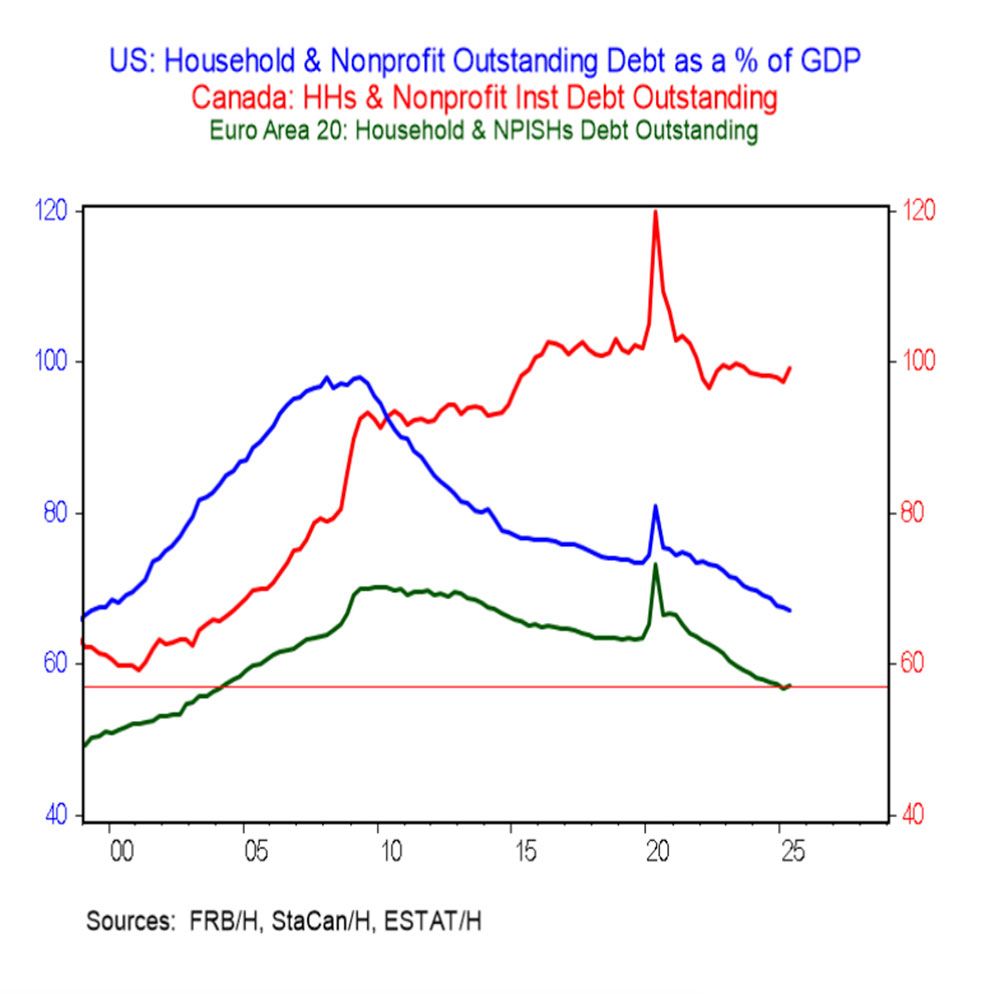
Canada is leading its peers, but unfortunately it’s in
household debt.
The
Institute of International Finance
(IIF) noted in its quarterly debt monitor last week that household debt is easing globally, down 1.4 percentage points to 67.4 per cent of GDP in mature economies in the third quarter.
The eurozone has never had very high household debt and now stands at about 57 per cent of GDP, said BMO chief economist Douglas Porter who brings us today’s chart. The United States was a high consumer debt economy before the Great Financial Crisis but that has moderated since then.
Canada, however, has gone the other way with household debt rising from 80 per cent of GDP before 2009 to around 100 per cent over the past decade “and showing no real sign of backing down,” said Porter.
“Among a sampling of 25 advanced economies, only Australia has higher household debt/GDP than Canada (at around 118 per cent),” he said.

- Today’s Data: Canada’s inflation numbers, existing home sales, housing starts and manufacturing sales, United States Empire manufacturing index, NAHB housing market index


- For Canadian snowbirds, the stay or go dilemma gets complicated
- Howard Levitt: Why remote workers keep winning in employment law disputes
- Trump’s tariff revenues fell for the first time since February

Amid boycotts and anger over the trade war and U.S. President Donald Trump‘s musing about making Canada the 51st state, Canadian snowbirds are feeling forced to choose between their country and their winter residences — second homes full of family, friends and fond memories. The Financial Post’s Garry Marr l
ooks at their dilemma.

Interested in energy? The subscriber-only FP West: Energy Insider newsletter brings you exclusive reporting and in-depth analysis on one of the country’s most important sectors.
Sign up here.
McLister on mortgages
Want to learn more about mortgages? Mortgage strategist Robert McLister’s
Financial Post column
can help navigate the complex sector, from the latest trends to financing opportunities you won’t want to miss. Plus check his
mortgage rate page
for Canada’s lowest national mortgage rates, updated daily.
Financial Post on YouTube
Visit the Financial Post’s
YouTube channel
for interviews with Canada’s leading experts in business, economics, housing, the energy sector and more.
Today’s Posthaste was written by Pamela Heaven with additional reporting from Financial Post staff, The Canadian Press and Bloomberg.
Have a story idea, pitch, embargoed report, or a suggestion for this newsletter? Email us at
posthaste@postmedia.com
.
Bookmark our website and support our journalism: Don’t miss the business news you need to know — add financialpost.com to your bookmarks and sign up for our newsletters here
Posthaste: Canada's provinces face 'deteriorating' outlook, says Fitch Ratings
2025-12-15 12:54:58