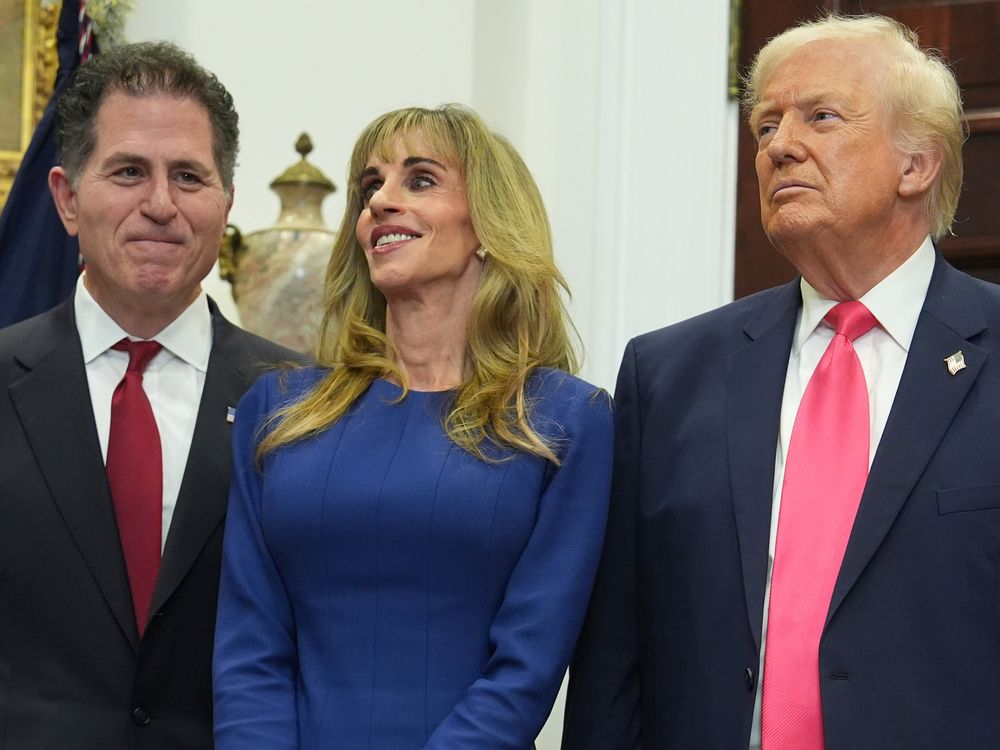

On Tuesday, Dell Technologies Inc. chief executive Michael Dell and his wife, Susan, announced a US$6.25 billion donation to fund “Trump accounts” for about 25 million American children. The accounts are a new investment and savings initiative that was first unveiled in President Donald Trump’s One Big Beautiful Bill this summer and is set to launch next year. Here, Financial Post breaks down what Trump accounts are, how they work and whether such an initiative could work in Canada.
What is a Trump account?
A Trump account is a type of tax-advantaged investment account that is intended to kickstart long-term
saving for American citizens
starting from birth, giving them a jumpstart on investment growth through time and compounding. It includes a proposed initial $1,000 contribution by the government.
Parents or guardians set up and manage the account until a child turns 18.
Jamie Golombek
, managing director, tax and estate planning at Canadian Imperial Bank of Commerce (CIBC) Private Wealth Management said it appears to be a multi-purpose account. The beneficiary could potentially use the funds to pay for their education, the down payment on a first home or as capital to start a business, as examples, he said. They can also choose to leave the funds invested for retirement.
These accounts will work somewhat like a traditional individual retirement account in the U.S., aside from the initial government contribution and limits on the types of investments allowed in the account. This includes tax-deferred growth, yearly contribution limits and penalties for early withdrawals. Financial experts still have questions about how details such as withdrawal taxes will work, as well as concerns about whether this will only benefit wealthier families.
“This is unlike basically anything we’d ever seen before, because not only is it a gift to transfer to children, but also there (are) pretty strict rules when it comes to investing in (these accounts),” said Pierre-Benoît Gauthier, vice-president of investment strategy at IG Wealth Management Inc.
How does it work?
Contributions to Trump accounts can begin on July 4, 2026. Parents and others can contribute up to US$5,000 a year into these accounts, while employers can contribute up to US$2,500 toward the US$5,000 maximum. Donations from foundations, state and local governments and other tax-exempt entities can be broad and do not factor into the annual contribution limit.
The U.S. Treasury and Internal Revenue Service (IRS) said the annual contribution limit is
indexed to inflation
and will adjust starting after 2027.
There are a couple of stipulations. The money must be invested in diversified, low-cost index funds that track U.S. companies, such as the S&P 500, and beneficiaries cannot make any withdrawals until they turn 18.
Gauthier said the big advantage with a Trump account is time.
“When you start (investing) at birth, compounding does the heavy lifting,” he said. “The earlier you start, the more the math works in your favour.”
The U.S. Council of Economic Advisers estimates that, assuming a scenario of average returns on the U.S. stock market, a Trump account balance for a baby born in 2026 will be US$303,800 by age 18 and US$1,091,900 by age 28, if maximum contributions are made.
Assuming no contributions are made beyond the initial $1,000, the council projects a balance of US$5,800 by age 18 and US$18,100 by age 28.
How are withdrawals taxed?
Once the beneficiary turns 18, the account is treated like a traditional individual retirement account (IRA) and is subject to typical IRA rules.
This means the account holder will pay a 10 per cent additional tax for early withdrawals before age 59 1/2, unless an exception (such as for higher education expenses or first home purchases) applies, the White House said.
“The idea is that (the Trump account) grows on a tax-deferred basis, and then when the kids take the money out, sometime after age 18, the contributions will come out tax-free,” said Golombek.
While parental contributions will not be taxed upon withdrawal, the earnings on these contributions will be, Golombek said. But this can get complicated, as federal seed money and contributions from charities and employers are considered earnings and are therefore taxable once withdrawn as well, he added.
He said there will likely need to be some sort of tracking of contributions and where they are coming from.
Who is eligible?
Any U.S. child under 18 who has a Social Security number will be eligible for a Trump account, which must be set up and managed by their parents or guardians until the child turns 18.
The Dells have pledged US$250 gifts to children aged 10 and under who were born before Jan. 1, 2025, and live in areas where the median income is below US$150,000. The U.S. government is also planning on making a one-time contribution of US$1,000 to seed accounts for children born between Jan. 1, 2025 and Dec. 31, 2028. It is unclear where the money for the federal contributions will come from.
Gauthier said that even though the accounts are said to benefit all newborn American children, he and other observers are concerned they will be most used by higher-income households who have the financial wherewithal to make the maximum $5,000 contributions every year.
“These accounts might help lower-income families build a small nest egg for their children, which is positive.”
Would the idea work in Canada?
While Golombek called the Trump accounts “innovative” he said the options we already have in Canada could simply be modified.
“I don’t see it coming to Canada anytime soon, but if it did come to Canada, I think we already have existing programs that could be tweaked to allow parents to save for their kids beyond just education through the RESP.”
Golombek said from a Canadian perspective, a Trump account would be most comparable to a
tax-free savings account
(TFSA), in which contributions are made with after-tax dollars and grow tax-free (although in the case of the TFSA, withdrawals are tax-free as well).
“If the (Canadian) government wanted to do this, we already have a system ready to go,” Golombek said. “We would just have to change the age of contribution for the TFSA, and we’d also have to allow other people to make contributions on behalf of that individual.”
Gauthier compared Trump accounts to a mix between a TFSA and a
registered education savings plan
(RESP), since the latter is a tax-sheltered account opened by someone on behalf of their child to which the government also contributes money.
With an RESP, contributions are made with after-tax dollars as well and are not taxed on withdrawal, but similar to a Trump account, any investment earnings that accumulated within a plan are considered taxable income when withdrawn, Golombek said.
However, the government matches 20 per cent of RESP contributions each year (up to a maximum of $500), which could make it a more attractive option than a one-time contribution offered in a Trump account, Gauthier said. The key difference is that an RESP is intended to finance post-secondary education specifically (with tax implications if the funds are used for other things), while a Trump account has broader use cases.
One
Canadian idea
along the lines of the Trump account comes from Joe Canavan, principal of venture capital firm Canavan Capital and former chairman and interim chief executive of the Children’s Aid Foundation. He proposed a government-funded program that would give Canadian children $10,000 in a federal savings account, with annual birthday contributions of $1,000 from ages 2 to 6 and $500 between 7 and 17. Parents and other family members could also make matching contributions, he said, and beneficiaries could access the account in 25 per cent increments as they age.
Investments in this account could also be tied to Canadian companies, circulating money in the Canadian investment ecosystem, he told Financial Post. His recommendation was that this program could be funded by gradually pushing back the Old Age Security (OAS) eligibility age from 65 to 67, as well as from tax revenues.
“If you want to bring hope and opportunity in one generation, to empower an entire country, this is how to do it,” Canavan said.
• Email: slouis@postmedia.com
What are ‘Trump accounts' and could the idea help Canadian families invest and build wealth?
2025-12-04 20:29:30