

Many Canadians are
retiring early
— not because they want to tour the world or bask on a beach — but because they have to, according to a new study.
Almost half of the retirees in a
survey by Manulife Group Retirement
this week stopped working earlier than they planned at an average age of 59 — and the bulk of these early retirements were for reasons beyond their control. Either they suffered a health issue, needed to care for a loved one or lost their job.
Only 15 per cent retired early because they had saved enough, which raises concerns about how prepared Canadians are for what could be an
increasingly lengthy retirement
.
“I was in good health until I wasn’t,” said one retiree in the survey. “Retirement comes faster than you think.”
Not only is retirement coming faster, Canadians are also living longer. Since 2023, life expectancy in Canada has risen two years to 83, and since 2001 the number of people over 100 has doubled, said the study. Globally, the number of centenarians is expected to grow by 800 per cent by 2050.
Instead of the 20 to 30 “golden years” of earlier generations, workers today are potentially looking at retirements that span 40 years or more.
“Longevity is rewriting the rules of retirement, and as it increases, we’re seeing more plan members questioning whether their saving and investment strategies will sustain them throughout retirement,” said Aimee DeCamillo, global head of retirement and wealth at Manulife Wealth & Asset Management.
That can be especially challenging in today’s economy.
Financial pressures on Canadians have escalated since the pandemic. The share of working Canadians who consider their financial situation fair or poor has risen from 33 per cent in 2020 to 41 per cent today, and those who consider their retirement savings behind schedule has jumped from 35 per cent in 2021 to 48 per cent.
The
high cost of living
and Canadians’ heavy debt loads have made working longer an increasingly popular idea, said the survey. The share of working Canadians who want to retire later has climbed from 26 per cent in 2020 to 35 per cent today, and in Manulife’s global study, 40 to 50 per cent of workers in all markets said they planned to work in retirement.
“Unfortunately, the reality in North America is that only 16 per cent of retirees surveyed work full or part time,” the study said. “And retirees surveyed stopped working far earlier than they’d planned, mostly due to their own health challenges or to care for a loved one.”
Manulife said many of the retirees in its study were surprised at how expensive retirement was and how fast they were going through their savings.
Over 60 per cent of early retirees had to make lifestyle adjustments to cut costs, while 32 per cent say they are more financially stressed in retirement than before.
Fewer had a formal retirement plan than Canadians who retired later and 11 per cent had no income other than government pensions, compared with 6 per cent of those who retired when planned.
“Plan ahead,” said one Gen Xer in the survey. “It’s here before you know it.”
The Last Toy Stores
Have you noticed that your neighourhood Toys “R” Us location has closed, or maybe that it’s up for sale? Well, the team at the Financial Post Western Bureau did, too. They’ve put together a five-part series called The Last Toy Stores exploring the changing landscape of toy retail in Canada as the country’s largest chain shrinks its footprint. You can read the first part, detailing the changes at Toys “R” Us, here, and visit the series home page at Financialpost.com every day this week for a new instalment.
Sign up here to get Posthaste delivered straight to your inbox.

Can you spot the subsidy?
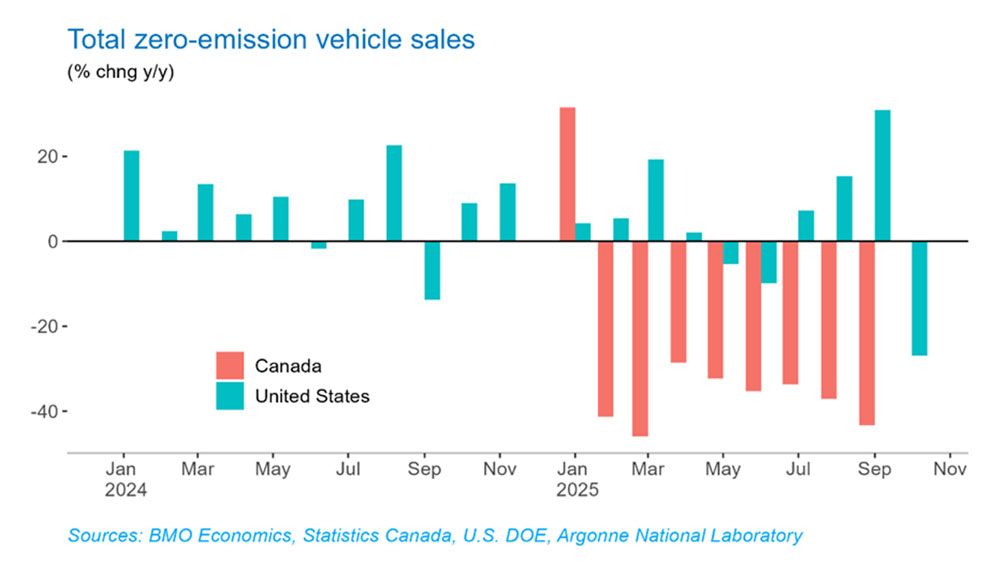
Today’s chart showing
electric vehicle sales
on both sides of the border highlights how important government aid is to the EV industry.
Canada’s incentive program, which offered $5,000 on new EVs and $2,500 on plug-in hybrids, ended earlier than expected, when it ran out of money in January.
The U.S. program, started by former President Joe Biden, which offered a $7,500 tax credit, died on Oct. 1.
In the United States, sales spiked 31 per cent the month before the subsidy ended and then plunged 27 per cent after it did, said Erik Johnson, a senior economist for BMO Capital Markets.
Canada’s sales fell off the cliff in February, and have been down an average of 37 per cent over the past eight months.
“Affordability remains the primary barrier as consumers focus on cost, and with many automakers scaling back EV production plans, the rollout of more affordable models is likely to take longer,” said Johnson.

- Today’s Data: Canada industrial and raw materials price index, United States existing home sales
- Earnings: Walmart Inc., Intuit Inc.


- ‘Ripples from the south’: Canadian newcomers concerned about declining job opportunities and U.S.-like deportations
- Bank of Canada deputy governor says country’s affordability crisis is linked to productivity
- The successes and setbacks of the Canadian retail magnate who built his career on broken businesses

Worried about leaving a big tax bill behind? This week Family Finance looks at how to leave RRIF, TFSA, property and other wealth to your children while avoiding probate and minimizing taxes.
Find out more
McLister on mortgages
Want to learn more about mortgages? Mortgage strategist Robert McLister’s
Financial Post column
can help navigate the complex sector, from the latest trends to financing opportunities you won’t want to miss. Plus check his
mortgage rate page
for Canada’s lowest national mortgage rates, updated daily.
Financial Post on YouTube
Visit the Financial Post’s
YouTube channel
for interviews with Canada’s leading experts in business, economics, housing, the energy sector and more.
Today’s Posthaste was written by Pamela Heaven with additional reporting from Financial Post staff, Canadian Press and Bloomberg.
Have a story idea, pitch, embargoed report, or a suggestion for this newsletter? Email us at
posthaste@postmedia.com
.
Bookmark our website and support our journalism: Don’t miss the business news you need to know — add financialpost.com to your bookmarks and sign up for our newsletters here
Posthaste: Are Canadians ready for the 40-year retirement? They may have no choice
2025-11-20 13:09:37