Two of the most powerful men in Ottawa share a history and experience, but what happens when times of crisis amp up natural tensions between the government and Bank of Canada?
Article content
Under normal circumstances, the governor of the Bank of Canada and the prime minister meet formally on occasion, a careful arrangement that allows them to touch base on the state of the economy while preserving their respective jurisdictions over monetary and fiscal policy.
In challenging times, those meetings can grow more frequent, something many central bank watchers expect in the coming months as U.S. President Donald Trump and his administration pursue trade policies that have rattled the global economic order.
Article content
Article content
Advertisement 2

Article content
For the foreseeable future, these meetings come with an interesting dynamic. Prime Minister Mark Carney is a former central banker himself, with an unprecedented resumé that includes leading the central banks of two G7 countries, while the current governor of the Bank of Canada, Tiff Macklem, served under Carney at the central bank as his senior deputy governor for three years.

Top Stories
Article content
People who know Carney and Macklem expect their shared history will allow them to smoothly navigate the relationship — one that has no extended precedent in the history of large developed nations — and put the government and central bank on a path to comfortably manage the natural tension between fiscal and monetary policy.
“Carney’s experience means he understands the appropriate relationship between a central bank and the government, and I think he would respect the independence of the central bank,” said Stephen Williamson, an economics professor at Western University who also holds the title of Stephen A. Jarislowsky Chair in Central Banking. “Further, given what I know about Macklem and Carney, even if there were differences to work out, in a crisis (for example), we’ll never hear about those differences. After all, they know that presenting a united front to the public in a crisis is critical.”
Article content
Article content
The unusual dynamic, however, also raises thorny questions about how things might play out if competing priorities can’t be easily balanced — especially if political pressure on the government rises.
“Ultimately, once somebody is an elected politician, they start behaving like an elected politician,” said Mark Manger, a political economy professor at University of Toronto’s Munk School of Public Policy. “And it doesn’t matter if they were central bank governor or if they have a PhD in economics from Oxford. They become a politician.”
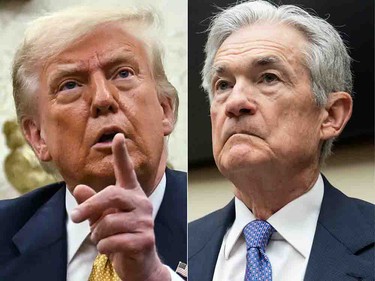
A worst-case scenario in relations between a political leader and the head of a country’s central bank is playing out in the United States in an escalating battle between U.S. President Donald Trump and Jerome Powell, chair of the U.S. Federal Reserve, who has come under increasing pressure to adhere to Trump’s demands that interest rates be slashed.
While no one expects anything close to a similar imbroglio in Canada, the Bank of Canada’s independence has been tested from time to time over the years. However, the relationship has not ruptured publicly since the Coyne Affair in 1961, when then prime minister John Diefenbaker squared off against Bank of Canada governor James Coyne, leading to Coyne’s resignation.
Article content
Lesser public tensions have cropped up in the years since, such as when the run-up of inflation following the COVID-19 pandemic put central bank policy more squarely in contrast with the desire of governments around the world to keep interest rates low to reduce the burdens of personal and government debt.
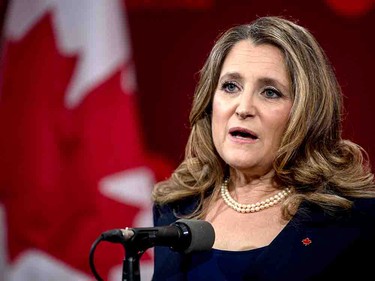
In September 2023, when the Bank of Canada was well into a months-long period of raising interest rates to cool inflation, putting pressure on Canadians with credit card debt and those facing mortgage renewals, then-finance minister Chrystia Freeland publicly referred to the Bank of Canada’s decision to hold rates as “a welcome relief for Canadians.” Her choice of words implied to many that Ottawa would not have been pleased with another hike and stoked debate about whether she was sending a not-so-veiled message to the central bank.
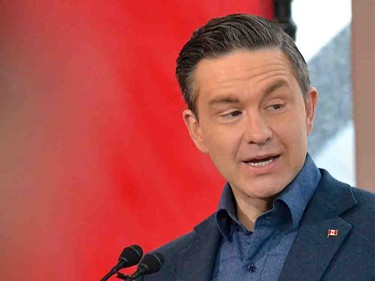
Conservative Party Leader Pierre Poilievre issued a more direct challenge to central bank independence when he threatened in 2022 to fire Macklem if elected prime minister. As leader of the official opposition, he publicly blamed Macklem for the rising inflation that was far from unique to Canada in the aftermath of the pandemic. Poilievre had already made a target of Macklem, calling him an “ATM” for the Trudeau government and its deficits.
Article content
Politicians wading into central bank affairs put into sharp relief how times of crisis can amp up natural tensions, with each having a district role to play in guiding a wide-ranging economy driven by sometimes conflicting forces.
A government might favour lower interest rates to ease the burden on homeowners and win votes — especially at times when the government, too, has taken on a lot of debt — but a key responsibility of central banks is to keep inflation in check, often through raising rates. On the other hand, when economic stimulus is necessary for the central bank to meet its targets for inflation and price stability, a government might find itself reluctant to add to deficits, fearing lost votes.
(Politicians’ comments) are not usually helpful because often they’re taking a simplistic view of things
Timothy Lane, a retired deputy governor at the Bank of Canada
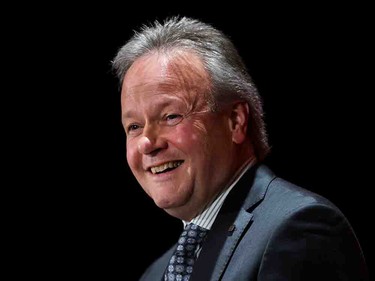
Timothy Lane, who was a deputy governor at the Bank of Canada until he retired in 2022, said that in crisis situations it is not uncommon to have politicians comment on monetary policy.
“(They) are not usually helpful because often they’re taking a simplistic view of things,” Lane said.
Other public comments from politicians have led to uncomfortable discussions about central bank independence over the years. In 2015, Joe Oliver, the finance minister, made an unexpected pronouncement about quantitative easing, which falls squarely within the Bank of Canada’s purview.
Article content
“Quantitative easing is not on the table,” he declared while visiting a Toronto university to promote expanded free trade, downplaying concerns at the time that Canada could be headed towards a recession.
But even when things have appeared smooth on the surface, there have been times when, privately, the government and central bankers are not in sync.
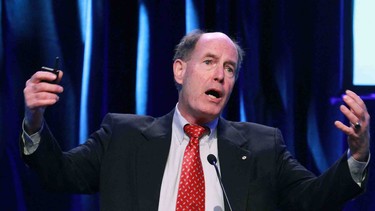
One such occasion was after the global financial crisis shook financial markets and economies around the world in 2008, according to David Dodge, who was governor of the Bank of Canada for seven years through January 2008.
Stephen Harper’s Conservative government had been focused on cutting taxes and was slow to introduce stimulus measures to support the economy, he said. The Bank of Canada responded to the growing crisis by rapidly lowering overnight interest rates from 4.25 per cent to just 0.25 per cent over the course of 2008 and 2009.
“The Harper government was running a fiscal policy which was too tight, especially after 2009,” Dodge said. “The (result) put real pressure on the bank to continue to maintain extraordinarily low interest rates to meet its inflation targets. So that was a period where co-ordination certainly did not take place.”
Article content
Despite Freeland’s public comments in 2023, there appeared to be more co-ordination when the COVID-19 pandemic closed all but essential business and services in March 2020. The government responded by rolling out billions of dollars in stimulus spending to households and businesses, while the Bank of Canada quickly lowered rates to support the economy and launched liquidity facilities and purchase programs to keep markets functioning and credit flowing while interest rate cuts worked their way through the economy.
Dodge, who worked with both Carney and Macklem during his years at the central bank, said there is no prohibition on communication between the government and the Bank of Canada. In fact, there is an expected degree of co-ordination between them.
There’s the big issue, always, of just how much support the bank is going to provide in terms of monetary policy
David Dodge, former Bank of Canada governor
While interactions directly with the prime minister can be somewhat rare, partly depending on whether a specific issue or crisis has arisen, he said there tends to be fairly regular contact between the governor of the Bank of Canada, the finance minister of the day and the department of finance.
“Our system envisages a discussion between the government and the bank in terms of a degree of co-ordination of monetary and fiscal policy. Independence of the bank doesn’t mean that the bank and the government don’t talk,” Dodge said.
Article content
“Certainly there’s the big issue, always, of just how much support the bank is going to provide in terms of monetary policy,” he added.
Central bank independence has been a cornerstone in most developed nations for decades, largely insulating them from short-term electoral considerations, through either legislation or practice, and leaving them to focus on keeping the economy from getting overheated and inflation in check.
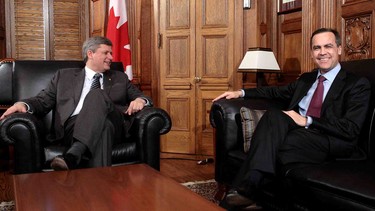
But Carney would be well aware of how even optics can raise questions about how beholden the Bank of Canada is to the government of the day. In 2011, when he was still governor of the Bank of Canada, prime minister Harper’s office released a photo of Carney seated across the desk from him in the prime minister’s office. Seated beside Carney was Harper’s finance minister Jim Flaherty. Carney was later, in an article written by the then-editor of the Globe and Mail, described as looking “uncomfortably like a political aide” in the photo.
According to that article by John Stackhouse, who is now a senior vice-president in the office of the CEO of Royal Bank of Canada, the relationship between Carney and Harper had grown chilly in the years before Carney left for the Bank of England in 2013. For one thing, he reported, Harper would summon Carney to his office, “at times speaking to him in a lecturing manner about the economy.” Tensions grew, according to the article, after Carney confided in private settings that Harper’s government had been slow to respond to the financial crisis.
Article content
Article content
Harper was no doubt a hands-on prime minister when it came to the Bank of Canada, keen to tap his two degrees in economics to discuss the bank’s research, according to a former central bank official who spoke on condition of anonymity.
“There is an extra layer of conversation there between two economists,” this person said. “Harper knew the governor’s job well, and was a big reader of economic research papers; he liked to discuss stuff like that.”
While these discussions were less than welcomed by some central bank officials, they did not bleed into steering the central bankers on the direction of interest rates.
“Not the actual conduct of monetary policy — never,” the former central banker said.
Over the past decades, the frequency and location of meetings and informal confabs have changed, depending on the situation and personal styles of prime ministers. Sometimes they have taken place in neutral locations, such as Ottawa hotels, while others have occurred in the prime minister’s office. Still others have taken place over the phone.
The current period of uncertainty with Donald Trump’s trade war and the potential for a recession is expected to lead to more interaction between central bankers and politicians than in predictable times. And they may not find themselves on the same page with monetary policy responses — particularly now that Carney will be at least perceived to have some regard for his political fortunes and that of his party.
Article content
“I suppose that Mr. Carney’s expertise might favour a certain type of monetary policy, but his political interests might favour something else — and that would be an interesting dynamic to observe,” said Paul Daly, a professor at the University of Ottawa who specializes in government institutions.
I suppose that Mr. Carney’s expertise might favour a certain type of monetary policy, but his political interests might favour something else
Prof. Paul Daly, University of Ottawa
If there is a disagreement and push comes to shove, Carney will have the edge, he said. While never been used to date, the Bank of Canada Act of 1985 gives the government leeway under certain conditions to direct the central bank on monetary policy for a specified period via “a written directive,” and even the power to get rid of the governor in specific circumstances.
“There are certainly many levers within the Bank of Canada Act that a Carney government could use to influence monetary policy, should it be so inclined,” Daly said.
Central bank watchers and former Bank of Canada officials say they don’t expect to see anything that dramatic, or even as overt as Freeland’s public statements in 2023. And simmering backroom friction seems equally unlikely, according to those who have worked with both Carney and Macklem.
“He (Carney) can pick up the phone,” Dodge said, adding that this in itself would not challenge the central bank’s independence. “Either one of them can pick up the phone.”
Article content
While informal discussions between the two men would probably stay behind closed doors, their existence would be made public if the government and central bank co-ordinated fiscal and monetary policy, particularly in a time of crisis, Dodge said.
“When the bank and the government clearly have talked and made a decision that their fiscal policy is going to work in a particular way, and monetary policy is going to support it, there’d be a communication that has taken place,” he said.
Article content
“Not the debate to get to that point, but communication after the fact is quite important in terms of coordination of policy — that is not perceived as undermining the bank’s independence, but rather that this was done explicitly for good reason, for economic growth, for economic stabilization, or whatever.”
In the early days of the coronavirus pandemic in March 2020, for example, then Bank of Canada governor Stephen Poloz frequently appeared beside finance minister Bill Morneau. Lane referred to this as presenting a united “Team Canada” approach.
When Carney and Macklem are sitting across from each other rather than beside each other as they did at the Bank of Canada, their relationship is unlikely to be comparable to a corporate world relationship of former boss and subordinate, said Western University’s Williamson.
Article content
“While Macklem was technically No. 2 to Carney’s No. 1, the governing council of the Bank of Canada tends to be a collegial group — at least that’s what they project,” he said, suggesting that reaching a consensus would be the norm for the two men even if Carney were weighing the political impact.
If there were to be a disagreement between Carney and Macklem, Lane, who worked with both at the Bank of Canada, said he doesn’t think the latter would feel beholden to his former boss.
“Tiff doesn’t owe his job to Mark Carney,” he said, adding that it was Justin Trudeau’s government, not Carney’s, that put him in the top job at the central bank. And while Macklem had served as senior deputy governor under Carney for three years, he returned as governor in 2020, seven years after Carney left.
Tiff doesn’t owe his job to Mark Carney
Timothy Lane, a retired Bank of Canada deputy governor
“Obviously they worked together, but I don’t think that really influences the degree of independence that Tiff would have.”
Lane retired from his role at the Bank of Canada six months into a steep period of interest rate increases to combat what had turned out to be persistent inflation. After a colossal 100-basis-point increase in July of 2022, Macklem said increases could have been started earlier, which may have blunted the need for such steep hikes.
Article content
In a hypothetical scenario where Carney, as prime minister, had a different interpretation than Macklem when looking at economic data, Lane said he would be likely to express it — but within bounds to preserve the Bank of Canada’s independence.
“He would understand that it’s not his role to try to influence what the Bank of Canada would do,” Lane said. “In that kind of situation…. It’s a judgment call and often there are some different ways of looking at (data) and different views, but somehow those have to be balanced to figure out what action to take.”
In such a scenario, receiving input from someone with Carney’s experience would be preferable to some of the political commentary the Bank of Canada dealt with in the past.
“The more different insights (that) go into the process, probably, the better,” he said.
Lane said Carney would also be sensitive to being on the receiving end of the ire of an unhappy politician, having drawn rebukes for his take on Brexit while governor of the Bank of England ahead of the crucial vote on Britain pulling out of the European Union.
“In the U.K., over Brexit, he had to give the Bank (of England’s) best analysis of what the consequences of Brexit would be, and that didn’t make him popular with a number of politicians,” Lane said. “But he was sticking in his role and that was as an independent, taking a clear, independent view of the economy.”
Article content
Powell, the Fed chair, has for months stood firm in his view that it is too soon to cut rates, despite the escalating public clash with Trump. While Trump called on him to either slash rates or resign, he has held his ground in asserting that Trump’s tariff war could push inflation higher.
But Trump has since turned to name-calling, dubbing Powell “stupid” and a “knucklehead” and pondering whether he should be replaced by someone such as Treasury Secretary Scott Bessent. Officials in Trump’s administration, meanwhile, accused Powell of either lying to Congress or grossly mismanaging the US$2.5-billion renovation of the Fed’s Washington headquarters. In an added insult, Bessent said in a July 15 television interview that the search was on for Powell’s successor, even though his current term doesn’t expire until next May.
To most observers, such a level of politicization in Canada is unthinkable, even if Carney and Macklem do not always agree.
“The close relationship between Macklem and Carney is obviously unusual but I don’t see any threat to central bank independence inherent in the situation,” said Paul Wachtel, professor emeritus at the Stern School of Business at New York University who conducted research on the topic.
“Both men know the value of central bank independence and are unlikely to cross any red lines,” he added. “I can’t imagine that Carney would in any way message the central bank that he knows better or try to influence their decisions. He has been an economist (and) central banker far longer than he has been a politician.”
• Email: bshecter@nationalpost.com
Bookmark our website and support our journalism: Don’t miss the business news you need to know — add financialpost.com to your bookmarks and sign up for our newsletters here.
Article content
Carney, Macklem duo brings unique dynamic to Canada
2025-07-24 16:25:43