


On Canada Day, Prime Minister
Mark Carney
called his “One Canada” Bill C-5 a “new national building permit that compels us to build, baby, build” just as uncertainty about its potential to help wean the country off its dependence on the United States continues to grow.
The bill, which includes ending federal barriers to
interprovincial trade
and fast-tracking infrastructure projects of national interest, “is not a silver bullet for remedying the blow to trade from U.S.
tariffs
,” Bradley Saunders, North America economist for Capital Economics Ltd., said in a new report.
There are a couple of reasons Saunders doubts the transformative powers of the bill, which is now law.
“The size of the gains available from lowering interprovincial trade barriers is contentious,” Saunders said.
Previous reports on ending interprovincial trade barriers have pegged their value at four to eight per cent per capita or as much as $200 billion annually in economic gains.
“We believe these figures are too high,” Saunders said, citing a survey by Statistics Canada that uncovered a sizable “lack of interest or need” for interprovincial trade on the part of businesspeople, while the remainder said that distance and transportation costs posed the greatest barriers.
Capital Economics’ concerns about the value of interprovincial trade to the Canadian economy were fleshed out in a report earlier this spring by business school Hautes études commerciales de Montréal (HEC).
HEC said the
potential economic gains
have been overstated because they overestimate the value of eliminating provincial exceptions in the Canada Free Trade Agreement (CFTA) and underestimate the effect of distance on provincial trade.
Weak productivity
also makes it harder for businesses to effectively compete across those distances.
Robert Gagné, director of the Centre for Productivity and Prosperity at HEC and one of the authors of the report, said the portion of the One Canada bill on interprovincial trade mainly covers the duplication in areas related to standards and regulations.
“There’s kind of a disconnect between what we hear from public officials saying, ‘Okay, it will be the next best thing,’” and what the reality is. Gagné said. “Does it mean that we should not look at this and try to clean that and make that more efficient? Of course not, but don’t expect a boost on our economy.”
Saunders at Capital Economics also said that interprovincial trade barriers had fallen by around 15 per cent over the two decades since the signing of two agreements in Canada but had failed to add to economic growth.
On Monday, Minister of Transport and Internal Trade
Chrystia Freeland
announced in a press release
that Ottawa had eliminated “all” federal exceptions from the CFTA, which mostly covered procurement. Provincial exceptions continue to exist.
So what about the big projects part of Bill C-5?
Gagné is more optimistic about what that portion of the bill can do for Canada.
Because business singled out transportation costs and distances as a barrier, he thinks Ottawa needs to get moving on building East-West corridors that include roads, railways and ships.
“Infrastructure is
in bad shape. It’s not very efficient. All the supply chain infrastructure East-West is not where it should be,” he said, adding that he likes such projects as the high-speed railway from Quebec City to Toronto announced by Justin Trudeau before he stepped down as prime minister.
Gagné said a project like that could help “shrink” the country in the same way data infrastructure has and also provide a critical link between two major regions of the country.
Saunders agrees the real gains lie with the big projects, but his second reason to not expect too much from C-5 relates to the years it will take for gains to “crystallize.”
Even if the federal timeline approvals are reduced to two years from five, it will still take years to get projects built, Saunders argued, using the Trans Mountain pipeline expansion as an example. That project was first proposed in 2013 and came online in May 2025.
He also argued that the number of projects needed to replace U.S. demand would be “huge” and difficult to identify given that they must meet five criteria to be deemed of “national interest.”
In the short-term, he said there aren’t any quick gains to be made from
easing
internal trade or Carney’s One Canada call out.
But that’s no reason not to push ahead, Gagné said.
“The level of competition in this country is not high enough, so because we do have a lot of regional markets which are isolated one from each other, let’s break this isolation and build strong, efficient infrastructure between markets, which will increase competition, force businesses to innovate, to invest, (and)
be more productive for the benefit of everyone,” he said.
Sign up here to get Posthaste delivered straight to your inbox.

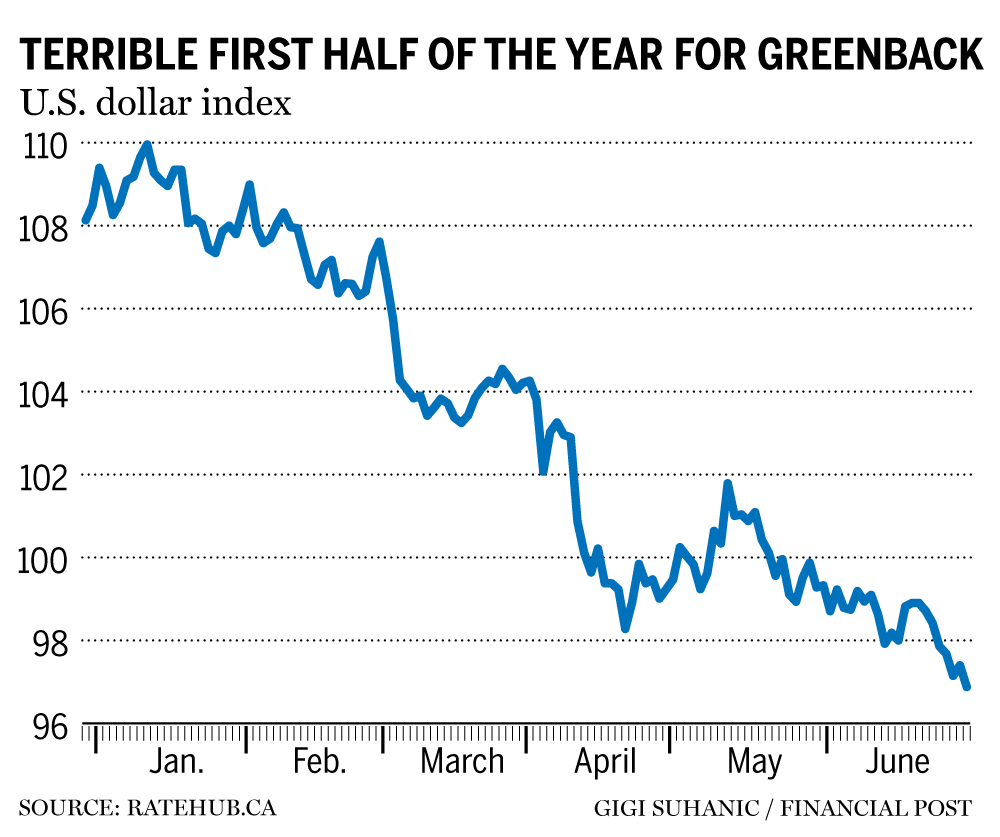
The U.S. dollar has suffered its worst first half of the year since 1973, as Donald Trump’s trade and economic policies prompt global investors to rethink their exposure to the world’s dominant currency.
The dollar index, which measures the currency’s strength against a basket of six others including the pound, euro, yen and Canadian dollar has slumped more than 10 per cent so far in 2025, the worst start to the year since the end of the gold-backed Bretton Woods system. — Financial Times
Read more here.

- Today’s Data: Canada S&P Global Manufacturing PMI, U.S. Challenger job cuts and ADP employment change
- Earnings: Constellation Brands Inc.


- Ottawa to curb steel imports with tariff rate quota on certain countries
- If Canada wants to be the world’s energy partner, we need to act like it
- Is real estate really the best place to park your money? A hard look at the numbers

For many Canadians,
retirement is a date
circled on a calendar rather than a concept. It is a moment in time when rush-hour commutes are replaced by long walks on the beach. The problem is not every senior wants to retire. An alternative approach could be envisioning a time when you work because you want to, not because you have to, but also have financial freedom to choose. Jason Heath walks us through
financial planning for the reluctant retiree.
Send us your summer job search stories
Financial Post published a feature on the
death of the summer job
as student unemployment reaches crisis levels. We want to hear directly from Canadians aged 15-24 about their summer job search.
Send us your story, in 50-100 words, and we’ll publish the best submissions in an upcoming edition of FP.
You can submit your story by email to
fp_economy@postmedia.com
under the subject heading “Summer job stories.” Please include your name, your age, the city and province where you reside, and a phone number to reach you.
Are you worried about having enough for retirement? Do you need to adjust your portfolio? Are you starting out or making a change and wondering how to build wealth? Are you trying to make ends meet? Drop us a line at
wealth@postmedia.com
with your contact info and the gist of your problem and we’ll find some experts to help you out while writing a Family Finance story about it (we’ll keep your name out of it, of course).
McLister on mortgages
Want to learn more about mortgages? Mortgage strategist Robert McLister’s
Financial Post column
can help navigate the complex sector, from the latest trends to financing opportunities you won’t want to miss. Plus check his
mortgage rate page
for Canada’s lowest national mortgage rates, updated daily.
Financial Post on YouTube
Visit the Financial Post’s
YouTube channel
for interviews with Canada’s leading experts in business, economics, housing, the energy sector and more.
Today’s Posthaste was written by Gigi Suhanic with additional reporting from Financial Post staff, The Canadian Press and Bloomberg.
Have a story idea, pitch, embargoed report, or a suggestion for this newsletter? Email us at
posthaste@postmedia.com
.
Bookmark our website and support our journalism: Don’t miss the business news you need to know — add financialpost.com to your bookmarks and sign up for our newsletters here
Posthaste: Carney's 'build, baby, build' mega-bill no silver bullet to neutralize blow from tariffs, says economist
2025-07-02 12:00:07