
The
Bank of Canada
chose
not to cut rates
at Wednesday’s policy meeting — a no-move at 2.75 per cent was fully priced in — but this is a “dovish hold” when you sift through the press statement.
Policymakers looked through the recent uptick in
gross domestic product
(GDP) growth to “the pull-forward of exports to the United States and inventory accumulation boosted activity, with final domestic demand roughly flat.”
In terms of looking ahead instead of back, they added that “
the economy
is expected to be considerably weaker in the second quarter, with the strength in exports and inventories reversing and final domestic demand remaining subdued.”
At the margin, there has been little change at the front end of the yield curve or the Canadian dollar in response to the sidelined central bank or the slightly dovish message.
At the same time, the statement said “
the labour market has weakened
, particularly in trade-intensive sectors, and unemployment has risen to 6.9 per cent.”
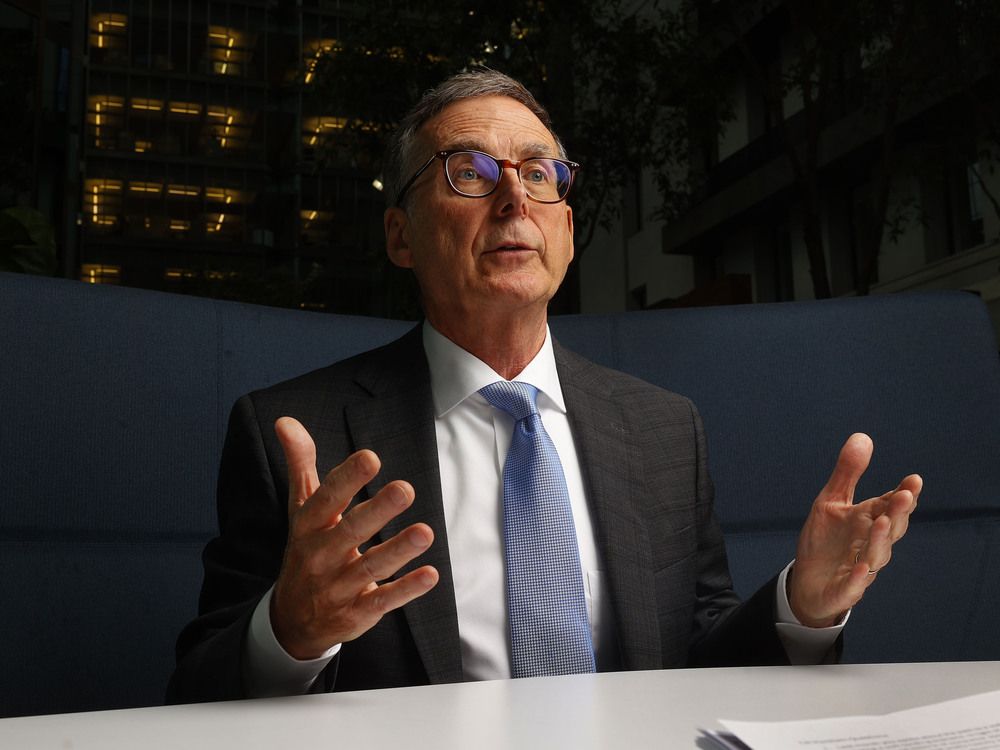
Tiff Macklem
, in his prepared commentary, tacked on that “businesses are generally telling us that they plan to scale back hiring.”
Let’s just report on what the historical record has to say about a two-year 1.8-percentage-point run-up in the jobless rate — a 90 per cent recession indicator (sifting through 50 years’ worth of data).
The excess slack in the jobs market was reason enough to cut rates on Wednesday, in our view, but the Bank of Canada made the point that the domestic economy, while soft, has not weakened as much as feared thus far from the tariff shock and mentioned the recent firmness in the consumer price index (CPI) data.
Policymakers concluded that, for now, this is a waiting game in terms of assessing the
tradeoffs on inflation
from the upside trade risks and the downside economic risks.
They said that ex-tax inflation is running at 2.3 per cent, which is within its comfort zone. The problem is rising unemployment and the impact this will have on real wages (negative) and then on inflation (lower) as demand contracts. That should be the primary focus, but it obviously wasn’t this week.
Because of the acute trade-related risks, in particular “the recent further increases in United States tariffs on steel and aluminum underline the unpredictability of U.S. trade policy,” Macklem said “we are being less forward-looking than usual,” but what was served in terms of guidance lined up on the dovish side: “On balance, members thought there could be a need for a reduction in the policy rate if the economy weakens in the face of continued U.S. tariffs and uncertainty, and cost pressures on inflation are contained.”
So,
rate cuts are still on the table
, but clearly will be situational. We feel more work is going to be needed.
The Canadian economy may not be collapsing, but to suggest that it is not fundamentally weak and expanding below its non-inflationary potential is foolhardy at best.
Underlying inflation trends are exactly where they were in September and October 2009, when the economy was crawling out of the great recession, and the policy rate sat at 0.25 per cent. This measure of inflation is close to where it was in April 2002 when the interest rate was 2.25 per cent.
In both cases, the worst for the economy was in the rear-view mirror, not staring us in the face as is the case today. More recently, just before COVID-19 hit, the Bank of Canada’s own “common” measure of inflation was again just about where it is currently, and the economy, at that point, was not considered to be on shaky ground, but the policy rate was being pinned at 1.75 per cent.
The less policymakers do now, the more they will have to do later. Remember the historical record: in recessions, the Bank of Canada ultimately brings the policy rate to a level that is 150 basis points below the prevailing “common” inflation trend, so calling for a move to the low end of “neutral” may end up being overly conservative.
The same holds true for the United States Federal Reserve once the ever-weakening “soft data” begin to show through in the “hard data,” especially the labour market. Both countries will likely be scrambling in the second half of the year to cut rates as the economic reality replaces the current high level of denial.
Remember what the Fed’s economics staff had to say in the last Federal Open Market Committee (FOMC) minutes from the May meeting:
“The staff projection for real GDP growth in 2025 and 2026 was weaker than the one prepared for the March meeting … the staff viewed the possibility that the economy would enter a recession to be almost as likely as the baseline forecast,” they said.
“With the drag on demand expected to start earlier and to be larger than the supply response, the output gap was projected to widen significantly over the forecast period. The labour market was expected to weaken substantially, with the unemployment rate forecast moving above the staff’s estimate of its natural rate by the end of this year and remaining above the natural rate through 2027.”
While the US$9 trillion of Treasury refinancing in the coming year will surely limit the extent of any monetary policy relief from south of the border, rate cuts from the Fed will be coming. It’s a waiting game at this point for the time when the tariff file is behind us.
Central banks will see, firsthand, that the negative real-side economic impacts will dominate. Any inflation will stop at the door due to a resistant consumer beset by widening labour market slack and declining real work-based incomes.
A return to Fed easing by the end of the summer will only help make the Bank of Canada’s work easier, and there is no doubt in our mind that the next moves in rates will be lower.
The only issue is the magnitude, and that should help act as a gravitational downward pull across the yield curve, notwithstanding some of the impediments that are already well known and priced in.
David Rosenberg is founder and president of independent research firm Rosenberg Research & Associates Inc. To receive more of David Rosenberg’s insights and analysis, you can sign up for a complimentary, one-month trial on the Rosenberg Research website.
Bookmark our website and support our journalism: Don’t miss the business news you need to know — add financialpost.com to your bookmarks and sign up for our newsletters here.
David Rosenberg: Tiff Macklem is looking like a deer caught in the headlights
2025-06-05 10:00:32