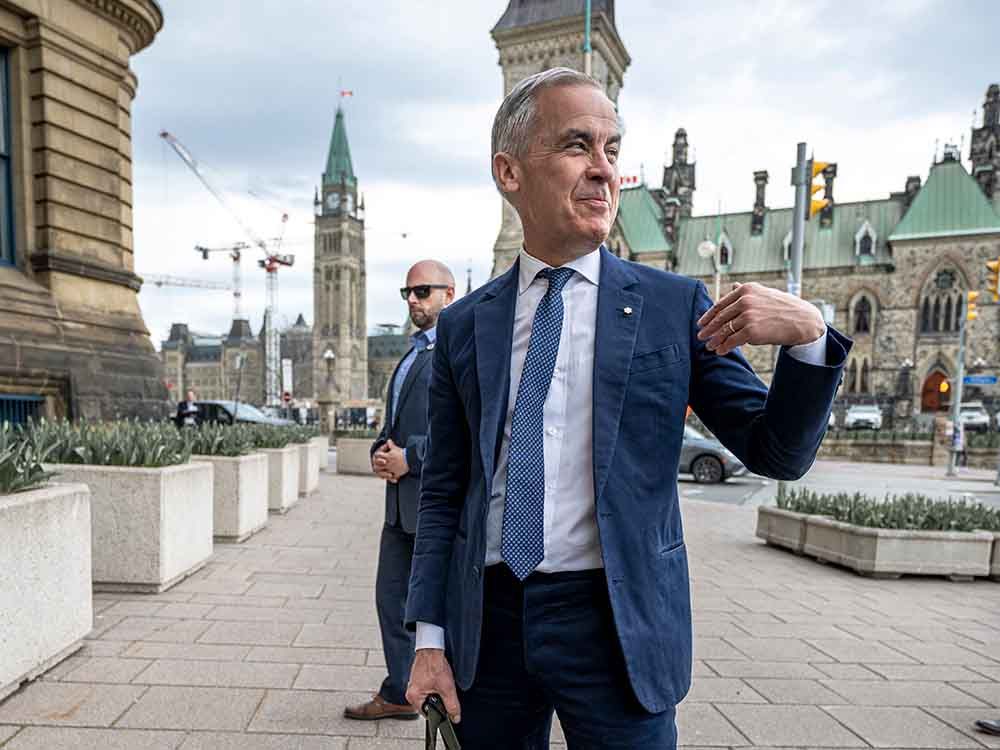

Economists say they expect the new Liberal government led by Prime Minister
Mark Carney
will look for support on an issue-by-issue basis rather than forming another coalition similar to what past prime minister Justin Trudeau had with the New Democratic Party to stay in power.
“There is enough overlap between the Liberal platform and each of the three other main parties that compromise can be found,” Robert Kavcic and Benjamin Reitzes, economists at
BMO Economics
, said in a note. “There might be brokering on a case-by-case basis.”
Minority governments tend to have shorter terms, so it is “crucial that the broader interests of Canada prevail,”
Toronto-Dominion Bank
economists, led by chief economist Beata Caranci, said in a note. “And now the rubber hits the road on collaboration and negotiations, with Liberals caught between the demands of the U.S. administration and those of domestic politics.”
Here are five areas of overlap the minority Liberal government could potentially tap into.
Taxes
“Both the Conservatives and Liberals included
tax cuts
as part of their platforms, with only minor differences between them,” TD said.
The Liberals called for the tax on the lowest bracket to be reduced to 14 per cent from 15 per cent, while the Conservatives said they wanted to drop it to 12.75 per cent. The NDP proposed raising the amount of untaxed income to $19,500 from the current level of $16,129.
“The Bloc Québécois will look for relief for seniors,” BMO said.
Deficits
Under the Liberals, “the deficit is set to widen sharply for (fiscal year) FY25/26 and subsequent years,” hitting $62.3 billion this year, or two per cent of gross domestic product (GDP), compared with a forecast of $42.2 billion in the fall economic statement, Kavcic and Reitzes said.
But
deficit spending
was a feature of all three of the main federal parties’ platforms, although the Conservatives forecasted a much smaller shortfall for this fiscal year of $31.4 billion, representing one per cent of GDP, while the NDP and the Bloc Québécois costed out deficits of $53.1 billion and $56.7 billion, respectively.
Kavcic and Reitzes said the Liberals’ deficit outlook assumed “decent economic growth” of 1.7 per cent this year, while they expect 0.7 per cent growth.
Defence
This area could represent a major budget line for the new government since the Liberals have pledged to spend two per cent of GDP on defence by 2030. The
Parliamentary Budget Office
said that translates into $24.9 billion, though that could change depending on economic growth.
Two per cent is the baseline spending level for
North Atlantic Treaty Organization
(NATO) members. TD economists said that target could rise to three per cent of GDP as other members ramp up spending, “leaving Liberals in catch-up mode from the current proposal.”
The Conservatives proposed a similar timeline to increase
defence spending
, pricing their plan at approximately $25 billion, while the NDP proposed hitting the NATO target by 2032.
Canada is projected to spend 1.4 per cent of its GDP on defence spending in 2024-25.
Tariffs
Liberals managed to pull their electoral prospects out of the flames thanks to
Donald Trump
dropping his
tariff bomb
on the world economy.
All parties proposed action to meet the tariff menace, with Conservatives urging the continuation of retaliatory tariffs that are already in place, including on $60-billion worth of U.S. imports into Canada.
The Liberals and the Conservatives also want to protect Canada’s automotive sector. The former proposed to create a $2-billion fund to help the sector’s workers build expertise, while the latter wants to cut the GST on Canadian-made cars as long as U.S. tariffs on foreign-made imports stand. The NDP proposed a similar plan and also favoured retaliatory tariffs.
Housing
All the parties had massive goals for building more
housing
and set targets that have never been met before by the construction industry.
The Liberals want to build 500,000 homes a year, the Conservatives wanted 2.3 million homes in five years and the NDP wanted three million over the same period.
Canada built around 240,000 homes in 2023, according to
Canada Mortgage and Housing Corp.
(CMHC) estimates, but the country only has the capacity to annually build 400,000 homes.
Both the Liberals and Conservatives offered to cut the GST on new home sales, but at different price points. The NDP called for the CMHC to offer “low-interest, public-backed mortgages.”
Both the Liberals and the NDP want to use Crown land to build housing, but the NDP wants it to be rent-controlled.
“Meantime, the minority standing opens up the possibility that more priorities need to be funded in order to garner support,” Kavcic and Reitzes said.
Sign up here to get Posthaste delivered straight to your inbox.


Distrust of the Liberals and longstanding frustration over the party’s policies on energy, including the Impact Assessment Act (Bill C-69 or the “no-more-pipelines act”) and the federal emissions cap on oil and gas, appear not to have been alleviated by Mark Carney’s campaign pledge to “build Canada strong” with a renewed focus on the economy.
A recent survey of energy executives and institutional investors suggests that Monday’s election outcome doesn’t bode well for oil and gas investment in the months and years ahead. —
Meghan Potkins, Financial Post
Read the full story here.

- Today’s Data: Canada releases GDP data for February. The U.S. releases a first quarter estimate for GDP
- Earnings: Loblaw Cos. Ltd., CGI Inc., Bausch and Lomb Corp., Methanex Corp., Spin Master Corp., Open Text Corp., Canadian Pacific Kansas City Ltd., Meta Platforms Inc., Microsoft Corp.



- A Toronto firm wants to buy Hudson’s Bay’s brand and charter, but expects a tough contest
- Oilpatch faces more frustration over federal environmental policies as Liberals take power again
- A time of fog of war:’ Shifting tariff plans on auto parts causing confusion in industry

This reader has a question regarding “
financial advisers
” offered by banks. She meets with one from time to time to review her financial plan but is essentially a DIY investor. She wants to know if bank advisers are compensated if they promote any funds that have commissions or fees. She also wonders if they are a good choice to bounce investing ideas off of. Read the answer
here.
Are you worried about having enough for retirement? Do you need to adjust your portfolio? Are you starting out or making a change and wondering how to build wealth? Are you trying to make ends meet? Drop us a line at
wealth@postmedia.com
with your contact info and the gist of your problem and we’ll find some experts to help you out while writing a Family Finance story about it (we’ll keep your name out of it, of course).
McLister on mortgages
Want to learn more about mortgages? Mortgage strategist Robert McLister’s
Financial Post column
can help navigate the complex sector, from the latest trends to financing opportunities you won’t want to miss. Plus check his
mortgage rate page
for Canada’s lowest national mortgage rates, updated daily.
Financial Post on YouTube
Visit the Financial Post’s
YouTube channel
for interviews with Canada’s leading experts in business, economics, housing, the energy sector and more.
Today’s Posthaste was written by Gigi Suhanic with additional reporting from Financial Post staff, The Canadian Press and Bloomberg.
Have a story idea, pitch, embargoed report, or a suggestion for this newsletter? Email us at
posthaste@postmedia.com
.
Bookmark our website and support our journalism: Don’t miss the business news you need to know — add financialpost.com to your bookmarks and sign up for our newsletters here
Posthaste: BMO, TD Bank economists jumpy about Liberal minority with Canada at dangerous crossroad
2025-04-30 12:00:54